When Poor Roads Factor Into Ohio Wrongful Death Claims: What a Wrongful Death Claim Covers
After a fatal collision, a damaged guardrail next to an Ohio curve is often the first thing people notice. But that damaged rail rarely tells the whole story. Speed matters. So do the vehicle's condition and who controlled that stretch of road.
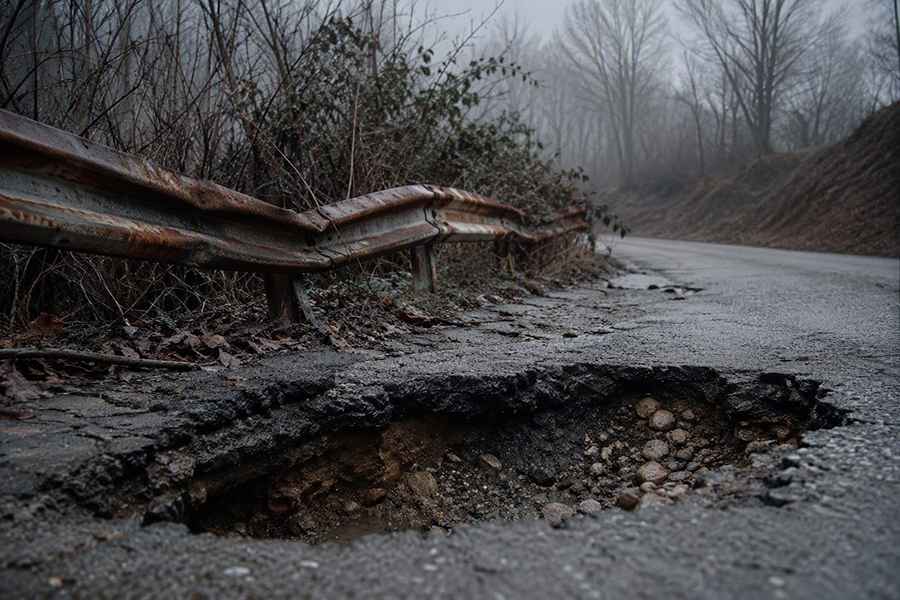
Under Ohio law, a poor road condition can form part of a wrongful death claim when evidence links a repair defect or an obstruction to the death. Claims against public roads come with their own immunity rules and filing requirements, and fault is often spread across more than one party. Read on for what a claim can cover once the road itself becomes part of the case.
When Can a Poor Road Condition Matter in an Ohio Wrongful Death Case?
A road condition becomes relevant once evidence ties a particular hazard to the death and supports a wrongful act that can be pursued. Ohio Revised Code Chapter 2125, including Section 2125.01, requires a wrongful act, neglect, or default that caused the death and that would have allowed the deceased person to sue had they survived.
Photographs alone prove nothing about causation. Investigators reason backward: without the alleged hazard, what would most likely have happened? If excessive speed alone would have caused the same loss of control on sound pavement, a nearby defect may have played no real part.
Possible factor | Investigation question | Useful proof |
Damaged pavement or obstruction | Did it change the vehicle's path? | Measurements and tire marks; repair records |
Missing or obscured traffic control | Was the device required and visible? | Traffic-control standards; vegetation records and earlier photographs |
Failed barrier | Did it contain or redirect the vehicle as intended? | Impact evidence; design and repair records |
Driver conduct | Did speed or distraction contribute? Was impairment involved? | Vehicle data and video; phone evidence and witnesses |
Vehicle defect | Did a component fail before impact? | Component inspection; service and recall records |
Severe weather | Did conditions affect traction or visibility? | Weather observations and road-treatment logs |
Fault is not always one person's. Ohio Revised Code Sections 2315.32 through 2315.36, including Section 2315.33, allow a deceased person's share of fault to reduce recovery in a negligence claim. Once that fault exceeds the combined fault of all other responsible parties, recovery is barred.
What happens if the evidence points to negligence?
When evidence points to negligence, two distinct claims can move forward together, though only one belongs to the estate. The representative files the wrongful death action for the family's losses, while a survival claim stays with the estate to cover the deceased person's own predeath injuries, medical bills, and pain. When evaluating what a wrongful death claim doesn't covers damages families can map each loss against Chapter 2125 well before the filing deadline in Section 2125.02(D)(1) runs out.
Which conduct can support an Ohio wrongful death action?
Negligent driving, negligent road maintenance, defective vehicle components, and other wrongful conduct can each serve as grounds. The claim must still satisfy the causation requirement in Section 2125.01. A dangerous scene alone is not enough.
What might road-related wrongful death allegations involve?
Two Ohio road scenarios illustrate how very different kinds of conduct can each demand investigation. Neither one means liability on its own; both would need supporting evidence and the right legal analysis:
- A local authority received documented notice of a qualifying repair defect, left it unaddressed, and the defect contributed to a fatal loss of control.
- A driver took a curve too fast, and a damaged barrier supposedly made the outcome worse, which raises shared-fault questions.
Who Could Be Responsible for a Fatal Crash Involving a Bad Ohio Road?
Potentially responsible parties include a driver or road authority, as well as a contractor or utility. A vehicle manufacturer may warrant investigation too. A claim against each defendant requires proof of an applicable duty and causation, and public defendants receive a separate immunity analysis.
State roads and local public roads are treated differently
Investigators must establish ownership and maintenance control for the collision location. Claims involving the Ohio Department of Transportation generally fall within the State of Ohio framework under Ohio Revised Code Section 2743.02 and the Ohio Court of Claims. Local-government claims generally require Chapter 2744 analysis.
Political subdivisions receive broad immunity under Section 2744.02, subject to exceptions and defenses. Section 2744.02(B)(3) addresses negligent failure to keep public roads in repair and negligent failure to remove obstructions. An exception alone does not establish liability; Section 2744.03 defenses may still apply.
Section 2744.01(H) excludes shoulders, berms, and rights-of-way from its public-road definition. Traffic-control devices are excluded unless mandated by the Ohio Manual of Uniform Traffic Control Devices. A design complaint is not the same thing as a repair claim.
Section 4511.11 governs traffic-control responsibilities and conformity with the Ohio manual. The manual's requirement matters here: a recommended device is not necessarily a mandated device. Vegetation obscuring a view requires analysis distinct from material physically obstructing travel.
Government control does not eliminate other possible fault
A driver's speed, a contractor's work, a utility excavation: each can demand its own investigation. Ownership alone does not establish liability, and a maintenance contract does not transfer every duty. Weather is a condition, not a defendant, but it can affect reasonable driving behavior and road-treatment questions.
Notice and time to respond may become important
Notice evidence can help establish negligent maintenance. Actual notice concerns knowledge of the specific condition; constructive notice concerns circumstances suggesting the defendant should have discovered it. The applicable standard shifts with the defendant and the claim.
A complaint identifying the same pavement defect weeks before a collision may support a stronger notice argument than a photograph taken afterward, especially when inspection records establish an opportunity to discover and address it.
What Evidence Should Be Preserved When the Road May Have Contributed?
The strongest evidence records the scene before it changes and links road conditions to vehicle movement. Preserve original files with their dates and locations intact, so later analysis can distinguish collision-day conditions from subsequent repairs.
Start with wide views and close photographs, without entering traffic or an unsafe scene. Document pavement edges and standing water. Images should also capture lane markings and signs, with lighting and sight distance assessed under comparable conditions.
Measurements can place skid or yaw marks relative to debris and the alleged defect. Record vegetation and barrier damage separately, along with temporary construction controls. Later photographs may mislead after crews make repairs or the weather changes.
Request the Ohio crash report and diagram promptly. Available 911 audio and dispatch records can establish timing; body-camera footage and traffic-camera recordings may show conditions before cleanup. Record witness accounts while memories are fresh.
Ohio road maintenance records can connect an observed defect to earlier complaints. Inspection reports and work orders may show what was reported and repaired. Repair contracts and construction plans help identify responsibilities, and prior photographs or documented incidents can establish a condition's history.
Compare weather observations against road-treatment logs; assumptions about ice or rainfall are not evidence. Preserve the vehicle before repairs or disposal. Depending on the model, an event data recorder may hold speed and braking data, plus throttle, steering, and restraint information.
Data availability differs by vehicle and holder, and lawful access and interpretation can take specialized help. Physical inspection may address tires and wheels first, then steering and brakes. Lighting and restraint components may need separate preservation. Keep the original files.
Ohio Revised Code Section 149.43 governs access to many agency records. Exemptions and investigatory status can affect disclosure; retention schedules and the record holder's identity matter too. Immediate release is not guaranteed.
A police report does not necessarily resolve civil fault. The officer may lack maintenance histories or a complete vehicle download when preparing it. Later engineering analysis can address questions absent from the initial diagram.
What a Wrongful Death Claim Covers Under Ohio Law
An Ohio wrongful death claim addresses losses suffered by statutory beneficiaries because of the death. Section 2125.02 permits recovery for lost support and services, loss of society, and qualifying mental anguish. It also recognizes lost prospective inheritance and reasonable funeral and burial expenses.
Who files, and who may benefit?
A wrongful death lawsuit must be filed by the deceased person’s personal representative, but any financial recovery goes exclusively to the surviving spouse, children, parents, or other legally recognized next of kin.
Section 2125.02 treats presumed injury differently among relatives. A sibling's relationship alone does not establish an automatic award. Distribution is not necessarily equal; it requires attention to each beneficiary's losses and Section 2125.03's probate framework.
Wrongful death and survival claims cover different injuries
A survival claim belongs to the estate and concerns the deceased person's own predeath injuries and losses. Section 2305.21 preserves qualifying causes of action after death. Pre-death medical expenses or conscious pain and suffering require analysis separate from the beneficiaries' wrongful death losses.
Punitive damages are unavailable under the wrongful death statute itself (R.C. 2125.02). However, punitive damages may be recovered through a properly supported survival claim (R.C. 2305.21) if the estate proves the decedent suffered pre-death injuries as a result of actual malice or egregious misconduct.
How Do Ohio Filing Rules Work When Road Conditions May Have Contributed?
An Ohio wrongful death action generally must be filed within two years of death under Section 2125.02(D)(1). That is a filing deadline, not the length of the lawsuit. Specific statutory exceptions and separate claims can demand their own analysis.
A state claim generally proceeds through the Court of Claims framework under Section 2743.02. Political-subdivision claims require Chapter 2744 analysis in the appropriate court. Private defendants may bring their own procedural requirements and insurance policies into play.
Don't wait until the deadline approaches to address preservation. Video gets overwritten. A vehicle gets sold or destroyed. Maintenance records sit on retention schedules that differ from one record holder to the next.
How much time can an Ohio fatal-collision lawsuit take?
There is no fixed duration. Disputed immunity and engineering analysis can affect the schedule, alongside probate matters and discovery. Settlement discussions and court availability matter too, and trial or appeal can extend proceedings. Section 2125.02(D)(1) does not set a completion date.
Where does payment for an Ohio wrongful death recovery come from?
Payment ordinarily comes from a liable defendant or an applicable insurer, sometimes both. Coverage terms and available assets affect collection. Public defendants also demand attention to statutory limits, including Sections 2744.05 and 2743.02; a verdict does not establish that every amount is insured or immediately collectible.
Related Questions About Ohio Fatal-Crash Claims
Individual evidence matters more than broad payout or success-rate claims. Chapter 2125 requires proof tied to the death and the beneficiaries' losses.
Can an average settlement predict an Ohio family's recovery?
No reliable average determines an individual claim's value. Section 2125.02 identifies compensable losses, but the evidence must establish those losses. Liability disputes and insurance limits affect recovery, and confidential settlements make online averages incomplete benchmarks.
Can a percentage predict success in an Ohio wrongful death case?
No fixed odds or statewide percentage responsibly predicts a particular outcome. Section 2125.01 requires causation, and public-road claims face Chapter 2744's separate immunity rules. The final result depends on proof of causation, available defenses, comparative fault, and governmental immunity. A photograph showing severe damage cannot substitute for proof connecting an actionable wrong to the death.
Can multiple defendants share fault for one fatal collision?
Yes. Separate conduct by a driver and a contractor, say, may contribute to the same death. Sections 2315.32 through 2315.36 govern comparative-fault issues, and immunity can independently prevent recovery against a public entity.
Preserve the Road Evidence Before It Changes
Preservation beats reconstruction. The strongest evidence does more than show a hazard existed; it establishes where the hazard was, how long it existed, who controlled it, and how it affected the collision. Seek case-specific Ohio legal analysis while you can still secure that evidence, not after every agency record arrives. A preservation request and a filed lawsuit do separate work; neither prevents road crews from making repairs or video recordings from disappearing.