Key Evidence that Can Help Strengthen Your Truck Accident Claim
Truck accidents in Illinois often cause serious injuries and frequently raise complex liability issues. Unlike other vehicle accidents, these crashes frequently require a more thorough investigation and documentation before liability is determined.
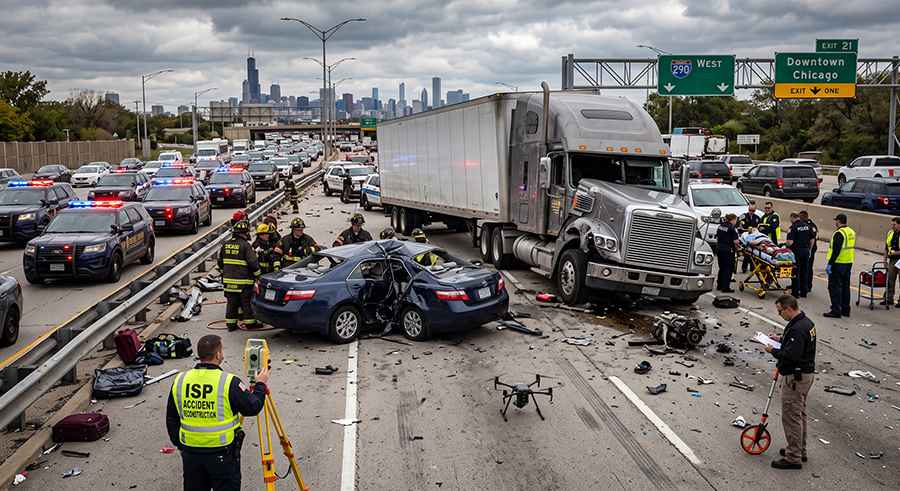
"Cases involving 18-wheelers are based on evidence that the majority of drivers are unaware of. The appropriate documentation can help determine the blame and make a claim much more effective," says attorney Michael P. McCready of McCready Law Injury Attorneys.
Knowing which types of evidence are most important can help you defend your rights after your truck is involved in a major collision.
Police Reports and Official Documentation
Police reports are official documentation that describes what happened at the scene. In Illinois, for example, police officers who respond to the scene normally document their observations of the road conditions, position of the vehicles, and their assessment of fault.
Citations issued to the truck driver can also be part of this report. A traffic offense, such as improper lane change or failure to yield, can shape one’s perspective on fault.
Official documentation goes beyond just police reports. Emergency medical reports and diagrams can help to further clarify what happened in the accident.
Photographic and Video Evidence
Photographs can be taken at the accident scene that capture important information before the vehicles are removed. Images of tire marks, road conditions, traffic lights, and the position of the vehicles can give a detailed account of the accident scene, which cannot be fully described in written form.
Close-up photographs of the damage to the vehicles can give valuable information on the direction and force of the accident. Such information can be helpful to accident reconstruction experts in explaining what happened during the accident.
Video evidence can give a clearer account of what happened during the accident. Sometimes, the accident is caught on camera by a dashcam, traffic cameras, or other surveillance cameras.
Witness Statements and Testimonies
Independent witness accounts give an impartial view of the situation that neither party can provide. Information about speed, abrupt lane changes, braking actions, or signs of distraction may help clarify the circumstances leading up to the crash.
If there were several witnesses who stated similar accounts of what they saw, these accounts may greatly help in the determination of fault. Third-party testimony is often used to support negligence claims in Illinois courts.
In more complex accidents, professional testimony may also be required. Accident reconstruction experts examine evidence to give an educated opinion about the probable sequence of events that led to the crash.
Electronic Data and Driver Logs
Trucks carry event data recorders that collect important information a few seconds before a crash. The information could be the speed at which the vehicles were moving, the application of the brakes, the performance of the engine, and the direction the vehicles were turned.
The electronic data could come in handy in the event of a crash. That information will be objective, making it difficult for anyone to contest the evidence.
Driver logs are equally important in determining whether the federal hours of service rules have been complied with. The electronic devices could indicate fatigue, which may have resulted in the accident.
Maintenance Records and Company Documentation
Trucking companies are required to maintain detailed records of the maintenance history of the vehicle. Brake changes, tire replacements, etc., are considered to determine the condition of the vehicle on the road.
In case of failure to properly maintain the vehicle, it is not just the driver who can be held accountable. The trucking company itself could also be held accountable under a theory of negligent supervision in Illinois.
The policies and training manuals of the trucking company could also come into play. They could reveal whether there was a failure to adhere to industry standards or not.
Conclusion
Evidence is what wins and loses cases of truck accidents rather than assumptions. The distinction between a controversial claim and a persuasive argument is always based on what was saved, examined, and produced.
In the case of commercial vehicles, more is at stake, and the documentation goes deeper. By moving as quickly as possible to retrieve important records and data, a much stronger position can be established than by relying solely on memory.