The Left Turn Might Be the Most Complicated Move You Make All Day
Nobody thinks twice about a left turn. Signal on, glance at oncoming traffic, wait for a gap, go. It happens so automatically that most drivers couldn't actually describe what they just did a second after doing it. Muscle memory, basically.
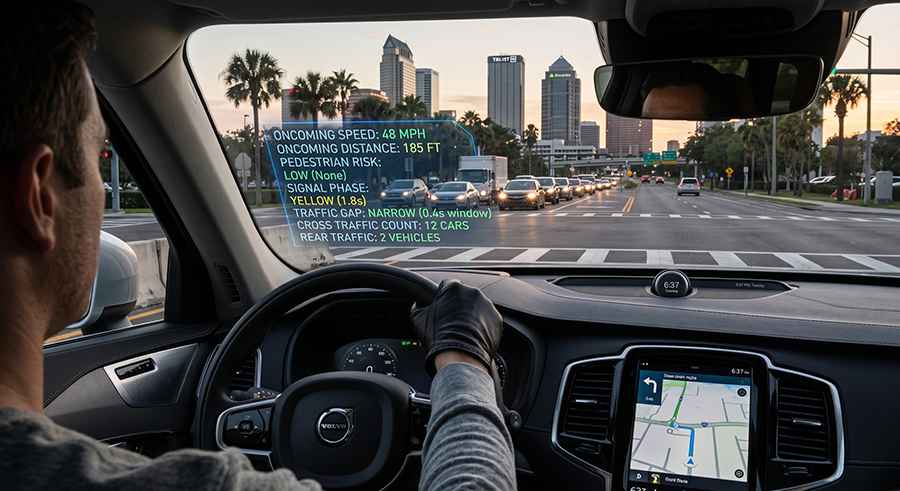
Except underneath that automatic feeling, a genuinely impressive amount of calculation is happening in just a few seconds. Speed of oncoming cars, distance, signal timing, pedestrians, other vehicles nearby, all of it processed almost instantly, without the driver consciously walking through any of it.
That hidden complexity is exactly what makes certain dangerous intersections in Tampa, FL so much riskier than others, since the margin for error on a maneuver like this is considerably thinner than it ever feels in the moment.
Your Brain Is Calculating More Than You Realize
Judging when to turn left involves estimating an oncoming vehicle's speed, its distance, and how much time is realistically available before it actually arrives. That's three separate calculations happening almost simultaneously, all before a driver even commits to the turn.
Traffic signals add another variable, timing the turn against a light that might change at any moment. Surrounding cars matter too, since a gap that looks clear can suddenly get complicated by another vehicle merging or changing lanes unexpectedly nearby.
All of this gets processed in a couple of seconds, which sounds impressive until you consider how little room there is for a miscalculation. Get any one of those estimates slightly wrong, and the entire equation falls apart fast.
The Car Coming Toward You Is Harder to Judge Than It Looks
Here's something most drivers never realize, human beings are genuinely bad at judging the speed of an object heading directly toward them, especially from a distance. It's a known perceptual quirk, not a personal failing, just how vision tends to work.
A car that looks comfortably far away can be closing that distance considerably faster than it appears, particularly if it's traveling above the posted speed limit. What felt like a safe, generous gap a second ago can shrink dramatically before a driver even finishes the turn.
That mismatch between perception and actual speed is responsible for a surprising number of turning collisions, not because drivers weren't paying attention, but because the gap genuinely wasn't as large as it looked from where they were sitting.
You're Not Just Watching the Cars
Oncoming traffic isn't the only thing competing for attention during a left turn. Pedestrians might be stepping into a crosswalk at the exact same moment. Cyclists can appear from an angle that's easy to miss while focused on oncoming vehicles.
Motorcycles present their own challenge too, since their smaller profile makes them considerably harder to spot than a car, especially glancing quickly across multiple lanes of traffic. Other turning vehicles add complexity as well, sometimes crossing paths unexpectedly depending on exact timing.
Changing lights and blocked sightlines pile onto all of this, along with traffic entering from side streets or driveways nearby. A left turn demands watching in several directions essentially at once, which is genuinely a lot to track in just a few seconds.
Some Intersections Make the Problem Even Harder
Not every intersection presents the same level of difficulty. Wide roads with multiple lanes require judging distance across considerably more space, adding uncertainty to every calculation involved in completing the turn safely.
Unusual geometry compounds this further, intersections that don't meet at a clean right angle, or that combine several merging roads at once, force drivers to process information that doesn't follow the pattern they're used to relying on instinctively.
Heavy traffic, poor visibility from parked vehicles or vegetation, and turn-lane design that doesn't leave much room to maneuver all add their own layers of difficulty. Nearby entrances and driveways introduce yet another source of unpredictable movement to watch for.
Conclusion
One of driving's most routine, forgettable maneuvers turns out to be a genuinely rapid sequence of decisions, made almost entirely on instinct, with very little room for error built into the whole process.
A small miscalculation in speed, distance, visibility, or timing is really all it takes to turn a completely ordinary left turn into something considerably more serious, especially at an intersection that's already stacking difficulty on top of difficulty.
Recognizing just how much is actually happening during those few automatic seconds helps explain why left turns remain such a consistent source of collisions, even for drivers who've made thousands of them without a second thought.