The Pothole That Annoys a Driver Can Terrify a Rider
A car rolls over a pothole and the driver barely notices, maybe a slight jolt, a muttered complaint, and it's already behind them. Four tires and a heavy chassis absorb most of it without much drama at all. Life goes on.
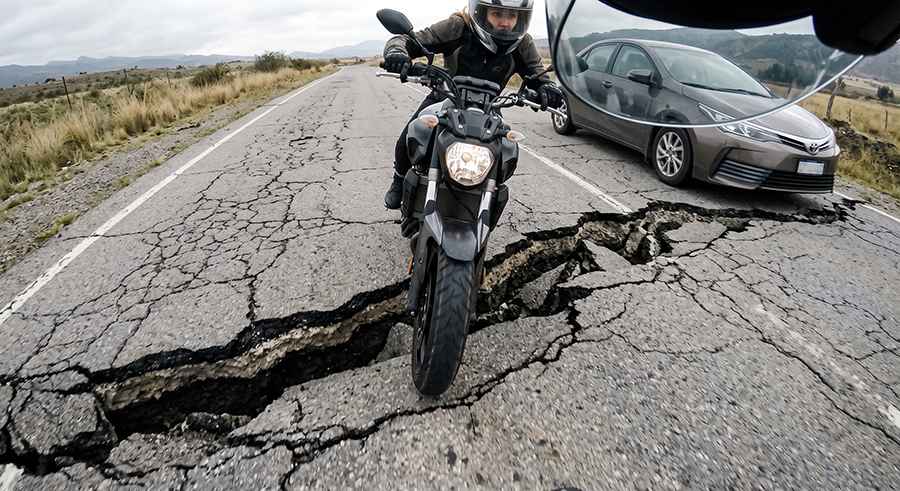
Put that same pothole under a motorcycle, and suddenly it's a completely different situation. Two contact patches instead of four, no stabilizing weight to fall back on, and a rider whose entire balance depends on staying upright through whatever the road throws at them.
That gap in consequence is really the whole story behind motorcycle road hazards, and it explains why riders end up thinking about pavement conditions in a way most drivers never really have to.
Small Road Defects Become Big Obstacles
Potholes are the obvious one, but they're far from the only culprit. Cracks running across a lane, uneven pavement from patch jobs that never quite matched the surrounding surface, utility covers sitting slightly proud or sunken, all of it adds up.
Debris counts too, a stray branch, a lost hubcap, a chunk of retreaded tire that fell off a truck somewhere down the highway. For a car, most of this is a minor nuisance. For a motorcycle, hitting the wrong piece at the wrong angle can genuinely destabilize the whole bike.
None of these defects are dramatic on their own. That's actually what makes them dangerous, they're easy to underestimate until a rider is already committed to a line that runs straight through one.
Traction Can Disappear Surprisingly Fast
A car doesn't think twice about a patch of gravel or a splash of oil. A motorcycle absolutely does. Traction is everything on two wheels, and it can vanish in an instant when the tire meets the wrong surface at the wrong moment.
Wet leaves are a particularly sneaky one, since they look harmless but turn shockingly slick the second moisture gets involved. Painted lane markings behave the same way in the rain, surprisingly slippery compared to the asphalt surrounding them.
Standing water adds its own risk too, sometimes hiding a pothole underneath, sometimes just reducing grip enough to matter. All of it means a rider is constantly reading the surface for hazards a driver would simply roll right over without a second thought.
Construction Zones Rearrange the Road
Construction zones throw out every assumption a rider normally relies on. Lanes shift into unfamiliar configurations, sometimes narrower, sometimes with no clear boundary at all. Surfaces switch abruptly from smooth asphalt to loose gravel or uneven grading.
Equipment sits parked in places it normally wouldn't, confusing sightlines and forcing sudden adjustments. Markings get confusing too, old lines still faintly visible underneath new temporary ones, leaving drivers and riders alike guessing at where they're actually supposed to be.
For a rider, all of this demands considerably more attention than cruising through a normal, well-maintained stretch of road. A construction zone essentially compresses a dozen small hazards into one short, unpredictable section.
Riders Have to Read the Pavement Ahead
Given everything that can go wrong, experienced riders develop a habit of constantly scanning the road surface well ahead, not just the traffic around them. Spotting a hazard early gives time to adjust smoothly instead of reacting suddenly at the last second.
Speed management plays into this too, since slowing down slightly through questionable stretches of pavement leaves more margin for error. Following distance matters as well, giving enough room to actually see and respond to whatever the rider ahead might be avoiding.
Positioning within the lane rounds this out, choosing a path that avoids the worst of the debris or cracked pavement whenever possible, rather than simply riding straight down the center regardless of what's actually there.
Conclusion
Ordinary imperfections in the road, the kind that barely register to anyone inside a car, turn into something genuinely worth respecting once you're balancing on two wheels instead of four. The margin for error just isn't the same.
That difference explains why riders develop such a particular relationship with pavement, constantly scanning, constantly adjusting, treating the road surface itself as an active variable rather than something to simply take for granted.
Understanding this helps explain why what looks like an overly cautious riding style is really just an accurate response to a genuinely different set of physics than everyone else on the road is dealing with.