How Heavy-Haul Crews Plan for Roads With Almost No Margin for Error
Moving an oversized industrial load gets complicated long before anyone puts the transport equipment in gear. A route that looks straightforward on a map can become unusable because of one bridge, one tight intersection, or one weak shoulder.
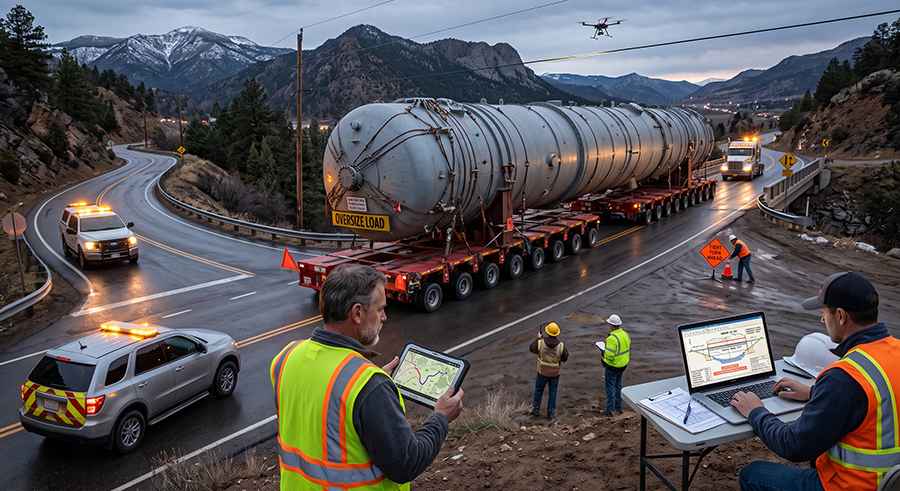
Steep grades, low overhead clearances, changing pavement conditions, road construction, and limited room at the destination can all determine whether a move is workable.
Heavy-haul route planning must answer a practical question: Can the complete transport configuration traverse the entire route with sufficient clearance to handle real-world conditions?
That takes more than checking mileage. Crews have to consider the load, transport equipment, roadway geometry, infrastructure, ground conditions, weather, and the places where a small change could stop the move.
Heavy-Haul Route Planning Starts With the Complete Load
A route survey has to account for the full loaded combination.
Cargo dimensions are only part of that calculation. Planners also need the loaded height, overall width and length, axle layout, axle spacing, turning characteristics, ground clearance, and the way the load will sit on the equipment.
Those details can change which roads are usable.
A bridge may provide enough clearance for the cargo itself while leaving too little room for the loaded transport height. A wide intersection may still be too tight once the combination's full swept path is considered. An industrial entrance that handles ordinary freight every day may leave nowhere for a much longer configuration to complete its turn.
Permitting has to enter the conversation early as well. The Federal Highway Administration notes that oversize and overweight permits are issued by states rather than the federal government, and requirements vary by jurisdiction. For moves crossing state lines, the route may have to satisfy several different permitting systems.
Survey the Entire Route, Including the Last Few Hundred Yards
Some of the most difficult parts of a heavy-haul move are nowhere near an interstate.
The final approach to a plant, construction site, substation, port, or industrial facility may involve narrow local roads, gravel, tight gates, drainage ditches, curbs, or shoulders that were never intended to support an extreme load.
A thorough route survey may need to account for:
- Bridge and roadway restrictions
- Lane and shoulder widths
- Intersections, medians, and traffic islands
- Utility lines and overhead structures
- Signs, poles, barriers, and guardrails
- Construction zones and temporary traffic patterns
- Staging and stopping areas
- Plant gates and final-site access
The shortest route can be a poor heavy-haul route if the crew has nowhere to turn, stop, stage, or recover when conditions change.
Grades and Curves Can Eliminate an Otherwise Workable Route
A steep grade creates more questions than whether the transport equipment has enough power to climb it.
Crews also have to consider traction, braking demands, pavement condition, grade length, and transitions at the top and bottom. A short, abrupt slope can create different problems from a long, steady climb.
Vertical geometry deserves attention too. Equipment with limited ground clearance can have trouble at crests, dips, railroad crossings, driveway transitions, and other sharp changes in road angle.
A route may have ample overhead clearance yet still create a clearance problem beneath the transport equipment.
Tight Turns Have to Fit the Whole Combination
Turning constraints become harder to manage as a transport configuration gets longer.
The path of the rear axles does not always follow the path of the front of the vehicle. As the combination moves through a turn, curbs, medians, signal poles, signs, barriers, parked equipment, and guardrails can get in the way.
That is why checking an intersection involves more than measuring lane width. Crews need to consider the full swept path of the loaded configuration.
The destination needs the same attention.
There may be enough room to reach a site but not enough to turn around, back into position, or line up for unloading. On some jobs, the last hundred yards demand as much planning as the hundred miles before them.
Bridge Limits Make Load Distribution Part of the Route Plan
Total weight matters, but crews also have to understand where that weight is carried.
Axle count and axle spacing affect how a load is distributed across road and bridge infrastructure. On the Interstate System, the Federal Bridge Formula considers both the number of axles in a group and the distance between them when determining allowable weight. The Federal Highway Administration explains that spreading weight across more axles or increasing axle spacing can reduce concentrated loading on a bridge.
Specialized oversize and overweight moves may operate under permits and project requirements that differ from normal highway limits. The details depend on the jurisdiction, equipment configuration, and load.
That makes route planning and equipment selection closely connected.
If a bridge does not work with the proposed configuration, the crew may need another route, a different axle arrangement, or additional project-specific analysis before the move proceeds.
Ground Pressure Matters Once the Pavement Changes
Bridges are only one part of the support problem.
A heavy-haul move may cross plant yards, temporary construction access roads, compacted stone, gravel, prepared staging areas, or pavement with questionable underlying support. Those surfaces can behave differently from a highway built for regular traffic.
Crews need to know where the transport will travel, stop, turn, and sit under load.
A shoulder that looks firm may not be suitable for supporting part of an extreme load. A staging area that routinely handles conventional equipment may still need closer evaluation before a much heavier configuration enters it.
Surface preparation can take several forms depending on the job. Mats, plates, reinforcement, or other measures should be based on actual ground conditions and project engineering rather than treated as universal fixes.
Overhead Clearance Involves More Than Low Bridges
Low bridges get plenty of attention, but they are only one source of vertical clearance problems.
Heavy-haul crews may also need to check:
- Utility lines
- Traffic signals
- Sign structures
- Trees
- Facility gates
- Pipe racks
- Plant structures
- Temporary construction features
Loaded transport height is the measurement that matters.
Road geometry can also change effective clearance. A dip, crown, slope, or uneven approach can change the position and angle of a tall load while it passes under an obstruction. A measurement that appears adequate on level pavement may need closer analysis when the road surface changes elevation.
Some obstacles can be avoided by choosing another road. Others may require advance coordination with a road authority, utility, site owner, or another responsible party.
Finding those conflicts during heavy-haul route planning gives the crew choices. Discovering them after the load has reached the obstacle can leave very few.
Road Conditions Can Change Between the Survey and the Move
A heavy-haul route is not fixed just because it was surveyed once.
Construction can narrow lanes or remove a planned turn. Pavement can deteriorate. Traffic control can change. A temporary closure can affect the permitted path. A shoulder that was firm during an earlier inspection may behave differently after several days of rain.
Federal Highway Administration research on oversize and overweight permitting notes that construction activity, work zones, traffic incidents, and weather events can affect routing and sometimes require changes.
For difficult moves, conditions near the scheduled transport date deserve another look.
Weather Can Reduce the Margin at Known Trouble Spots
Rain, snow, ice, wind, and poor visibility can make an already demanding route harder to use.
A steep grade offers less room for error when traction is poor. Soft ground can become a larger concern after sustained rain. Strong winds can complicate movement when a load presents a large exposed surface area. Poor visibility can make tight positioning and traffic coordination more difficult.
The useful approach is to connect weather planning to specific points along the route.
Instead of treating bad weather as one general concern, crews can identify which conditions would make a particular grade, turn, surface, or staging area unacceptable. That gives the team a clearer basis for deciding whether to continue, delay, or change the plan.
Heavy-Haul Equipment Has to Match the Road
Carrying capacity is only one part of choosing equipment for a heavy move.
Deck height, axle configuration, overall length, weight distribution, ground clearance, steering characteristics, and maneuverability can all affect whether a transport system is suitable for a particular route.
A lower deck may help with overhead clearance. Additional axle lines may provide more options for distributing weight. A different wheelbase or steering arrangement may make a difficult turn more manageable.
The useful question is specific: Which configuration can carry this load through this route and put it where it needs to go?
When Modular Transport Systems Enter the Plan
Some industrial loads push beyond what is practical for conventional heavy-haul equipment.
That may happen when the cargo is exceptionally heavy, has unusual support requirements, or has to move through a restricted plant, yard, construction site, or industrial facility.
Modular transport systems give crews more flexibility in arranging axle lines and support points around the load. Self-propelled modular transporters can also provide additional maneuvering options for controlled movement in tight operating areas.
Cometto's MSPE self-propelled modular transporter system, for example, uses electronic steering and allows modular units to be combined in different configurations. Cometto identifies applications that include transformers, industrial components, offshore structures, power-generation equipment, bridge sections, and other specialized heavy loads.
Cometto's ModulMAX SP-E is another self-propelled modular option. According to the manufacturer, the system uses electronically controlled steering and can provide steering angles of up to ±140 degrees, which can help when precise movement is required in restricted areas.
Modular equipment still has to be matched to the job. Surface capacity, load support points, route conditions, project engineering, permits, and operating requirements all affect what equipment can be used.
Contingency Planning Starts With Known Weak Points
A backup plan is useful when it addresses a real problem the crew may face.
During the route survey, planners can flag the locations most likely to interrupt the move. That may be a steep grade, tight intersection, bridge, weak surface, low clearance point, staging area, or difficult site entrance.
From there, the team can work through practical questions before the load arrives.
Where can the convoy stop if access is blocked? Is there room to stage before the difficult section? Is an alternate permitted route available? Who needs to be contacted if conditions change? What happens if construction affects the original path?
These questions matter because an oversized load cannot always make a simple detour.
The Federal Highway Administration notes that oversize and overweight movements may be restricted to routes specified through state permitting systems.An unplanned route change can introduce new bridge limits, clearances, turning constraints, or permit issues that have not been evaluated.
Communication also has to be clear. Drivers, escorts, site personnel, engineers, permit contacts, and equipment operators should understand the route, the difficult points, and the plan for handling a change.
The Best Heavy-Haul Route Leaves Room to Work
The shortest road is not automatically the best road for an oversized industrial load.
A route that barely clears every known constraint may offer little room for construction changes, poor surfaces, weather, unexpected obstructions, or a difficult final approach.
Strong heavy-haul route planning considers the road and the equipment as a single system. Grades affect traction and clearance. Bridges influence axle configuration. Ground conditions affect where a load can stop or turn. Overhead obstacles affect transport height. Tight sites may change the type of equipment that makes sense for the move.
The goal is a route with enough usable margin for the crew to handle the conditions they are likely to face.
For specialized heavy-load projects where load distribution or maneuverability is a major concern, Hale Trailer can help customers review available Cometto and modular transport equipment for the job.
The wheels may turn for only a few hours. Getting those hours right starts with the road, the load, and the equipment long before the move begins.
About the author:
Hale Trailer provides commercial trailer sales, rentals, parts, and service, backed by nearly 50 years of industry experience. With a broad inventory that includes specialized heavy haul equipment, Hale Trailer helps construction, logistics, fleet, and industrial customers find the right trailer for the job.