What It Actually Takes to Ship Your Vehicle to Another Continent
Moving a vehicle across an ocean sounds like a logistics problem. It is really a paperwork problem wearing a logistics costume. The physical part — a car sitting on a ship for three to six weeks — is the easy half, handled by companies that move thousands of vehicles a month without much drama.
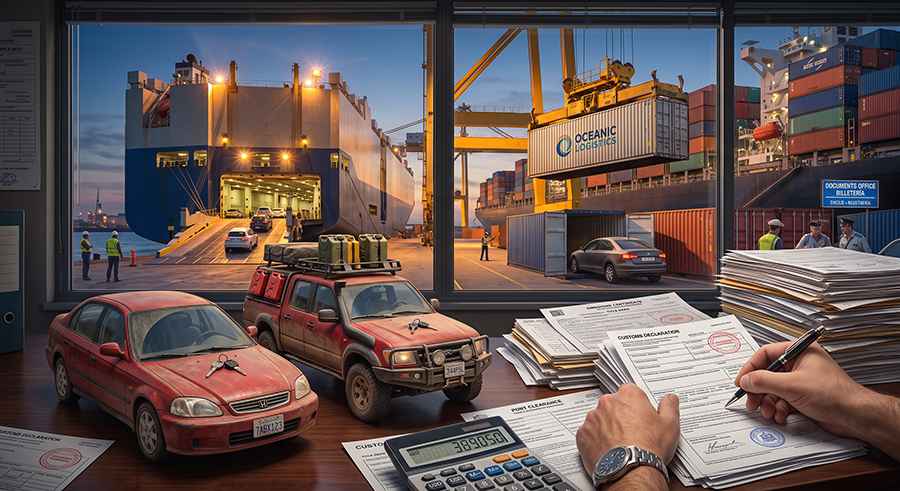
The hard half is everything that surrounds it: customs forms, ownership proof, emissions rules, port fees you didn't know existed, and payments that have to reach a company you've never met in a country where you don't hold an account.
People underestimate this in a predictable way. They price the freight, decide it's affordable, and book. Then the invoices start arriving from four different parties, half the documents need stamps from agencies that close at noon, and the delivery window slips by two weeks. None of that means shipping a vehicle is a bad idea. It means the actual work sits in places most people don't think to look until they're standing in a port office holding the wrong form.
Choosing How the Vehicle Travels
Two methods dominate ocean freight for vehicles, and the choice shapes cost, risk, and how much preparation you need to do.
Roll-on/roll-off
RoRo ships are floating parking garages. Your vehicle is driven up a ramp, parked, chocked, and strapped down alongside hundreds of others. It's the cheaper option, usually by a wide margin, and it's the standard for anything that drives under its own power.
The trade-off is exposure. Port staff will drive your vehicle, so it needs to be operational and you'll have to hand over a key. Nothing loose can stay inside, because the vehicle isn't sealed and personal belongings are generally not permitted. Roof boxes, jerry cans, and recovery gear either get removed or get inspected and often rejected. RoRo also runs on fixed routes between major ports, which is fine for common corridors and frustrating if your destination isn't one.
Container shipping
A container gives you a locked steel box. The vehicle is driven or winched in, secured to the floor, and the doors are sealed until customs opens them. You can usually pack equipment inside the vehicle, which matters enormously for overland travelers carrying tools and camping gear.
Containers cost more and add a step at each end, since the vehicle has to be loaded and unloaded at a facility rather than driven onto a ship. Sharing a 40-foot container with another vehicle cuts the price considerably, though it means matching schedules with a stranger and accepting whatever delays they create. Anything oversized — a tall camper, a heavily built truck — may not fit in a standard container at all, which pushes you back toward RoRo or into flat-rack territory at a steep premium.
Paperwork Comes Before Anything Else
Whichever method you pick, no ship will take the vehicle until the documents are clean. Start here, because timelines are driven by government offices, not by shipping lines.
Proving the vehicle is yours
Every export requires clear title. Not a bill of sale, not a registration card alone — the original ownership document, with no lien attached. If a bank still holds a loan on the vehicle, you'll need a written release, and that alone can take weeks.
Departure countries impose their own export rules on top of that. In the United States, Customs and Border Protection requires the vehicle and its title to be presented at the port a set number of business days before it sails, and missing that window means missing the sailing entirely. Destination countries then apply their own import standards. American rules on what may enter and under what conditions are published by NHTSA, and most countries maintain something comparable covering age limits, emissions, and safety equipment.
The carnet de passages
For temporary imports — you're touring, not relocating — many countries in Africa, the Middle East, and parts of Asia require a carnet de passages en douane. It functions as a customs passport for the vehicle, backed by a financial guarantee that you won't sell it locally.
That guarantee is the expensive part. Issuing bodies affiliated with the FIA typically require a bond or deposit calculated as a multiple of the vehicle's value, and in high-duty countries that multiple can be several times what the vehicle is worth. The money comes back once the carnet is properly discharged with exit stamps at every border. Miss a stamp and the claim process can drag on for a year.
Preparing the Vehicle Itself
Physical prep is more specific than most people expect. Fuel usually has to be under a quarter tank. Alarms need disabling, since a battery drained by a shrieking alarm mid-voyage arrives dead. Loose parts get removed or secured, gas bottles come out, and lithium batteries face their own restrictions.
Photograph everything before handover — every panel, the odometer, the interior — with timestamps. Cargo insurance is separate from your regular policy and usually costs between one and two percent of declared value. Skipping it is a gamble against salt air, rough handling, and the reality that proving damage occurred at sea is difficult without a documented starting condition.
Paying Everyone Across Borders
Shipping a vehicle generates payments to parties in at least two countries, often three. The freight forwarder, the shipping line, the destination port, the customs broker, and sometimes a local agent all invoice separately, in their own currencies, on their own schedules. Several will demand payment before releasing the vehicle, which puts you on a clock.
This is where costs quietly inflate. A traditional bank wire carries a flat fee at each end, and correspondent banks in the middle often deduct their own charges, so the amount arriving is less than the amount sent — leaving you short on an invoice you thought you'd paid. The larger loss usually hides in the exchange rate, where a spread of two or three percent above the mid-market rate turns a routine payment into an expensive one.
Dedicated services that transfer money overseas generally price closer to the real rate, show the recipient's exact amount before you confirm, and settle in one to three business days rather than the vague window a wire provides. For a shipment where the total bill runs into five figures across four or five separate payments, the difference is measured in hundreds.
Practical habits help as much as pricing. Ask each party which currency they invoice in, because paying a euro invoice in dollars hands the conversion to their bank at their rate. Keep confirmation records for every payment, since port offices frequently release vehicles against proof of payment rather than a cleared balance.
Clearing the Vehicle at the Far End
Arrival is not delivery. The vehicle sits in a bonded area until customs releases it, and that release depends on documents, duties, and inspections.
A local customs broker is worth hiring almost everywhere. They know which office stamps what, which forms have changed, and how to avoid the storage charges that accumulate daily once the free period ends — usually three to seven days. Duties and taxes are assessed on the vehicle's declared value, and the rates vary enormously by country and vehicle age. Budget for temporary local insurance and registration too, because most destinations won't let the vehicle leave the port area without both.
Bringing It Together
Shipping a vehicle overseas is achievable for anyone willing to treat it as an administrative project rather than a booking. The freight is a commodity, priced competitively and handled routinely. What separates a smooth shipment from an expensive one is the preparation around it: documents assembled early, rules checked against both departure and arrival requirements, payments planned rather than improvised, and enough slack in the schedule to absorb the delays that arrive regardless.
Start the paperwork well before you start comparing quotes. Assume every step will take longer than quoted. Budget past the freight figure to the fees that follow it. Do those three things and the ocean crossing becomes the least complicated part of the whole undertaking.