How Rain and Work Zones Change Safe Driving Around Trucks
Missouri interstates feel smaller in heavy rain. Truck spray hangs in the air long after the trailer has passed. Lane markings disappear under the water sitting on the pavement. Add a work zone to that and the margin you're used to is gone.
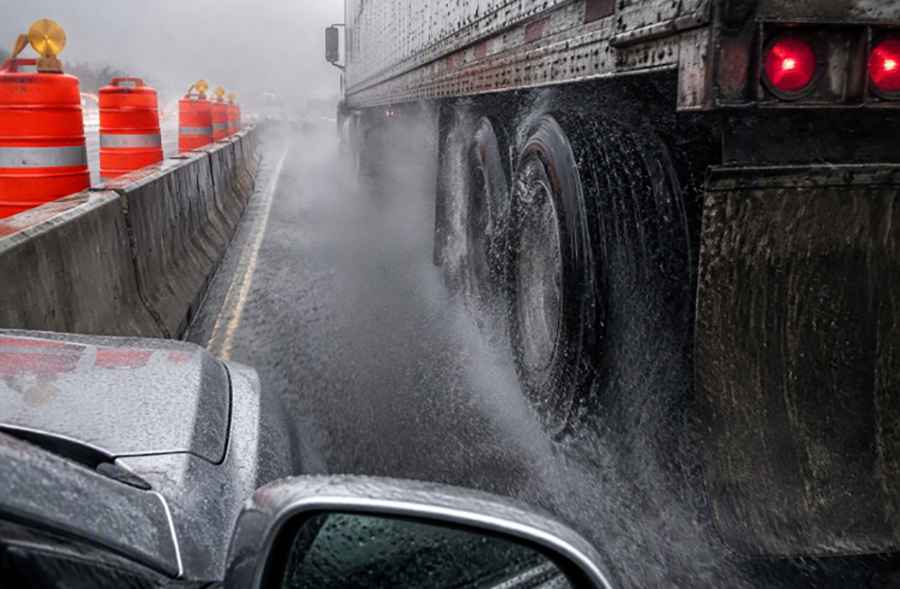
Safe driving around trucks in those conditions requires more room and earlier decisions than a dry-road routine allows. Halvorsen Klote Davis reports that Missouri averages more than 40 truck crashes per day, a historical daily average drawn from 2020 FMCSA data, which counts property-damage-only crashes alongside injury and fatal ones. When a car is involved, the people in it are most exposed.
Safe Driving Around Trucks: Set a Safe Following Distance Behind a Truck in Rain
Ease your speed down smoothly and open up the space in front of you: enough to stop progressively if the truck slows or simply vanishes behind its own spray. Don't sit beside a trailer any longer than the maneuver takes.
A fixed number of meters or feet is the wrong unit for this. Stopping distance grows with speed, so a time gap scales with you while a fixed distance doesn't. Set your normal dry-road gap first, then add time when standing water or thick spray starts cutting into your traction and your sight distance.
Before you commit to a specific number of seconds, check the current Missouri Driver Guide for the state's own following-distance guidance. No single time gap covers every condition, and an informal rule you picked up years ago isn't necessarily a Missouri standard.
What Does the 7/3 Rule Mean in Trucking?
The 7/3 rule is an Hours-of-Service split option that lets truck drivers meet their 10-hour off-duty requirement with a seven-hour block in the sleeper berth plus a separate three-hour off-duty period. Contrary to common driver-ed misconceptions, it has nothing to do with following distance.
The sequence matters more than the arithmetic. Lift off the accelerator rather than braking hard, and let the truck pull far enough ahead that you can see pavement and markings again. Watch its brake lights, and where sight lines allow, the traffic beyond it.
Hydroplaning deserves respect. Turn off cruise control the moment traction starts changing, and keep your steering inputs small. Slow down before you reach pooled water, not while you're crossing it.
What to Do When Truck Spray Blocks Visibility
Hold your lane position and ease off the accelerator until the markings and the traffic ahead come back into view. No hard braking, no sharp steering.
Your instinct may be to accelerate out of the cloud. Resist it. Passing without a clear view can put you alongside a trailer at the exact moment you can't see the lane line or the barrier beside it, which turns a visibility problem into a positioning problem you can't easily correct.
Much of this is settled before you leave the driveway. Clean glass and wipers that clear instead of smear do more in heavy spray than any technique behind the wheel. Check your washer fluid, defroster, and headlights while you're at it, and remember worn blades take only a few minutes to swap.
Pick your visual references before you're in the cloud. The right-hand lane line works, and so do temporary work-zone markings when they're in force. What doesn't work is steering by a truck's taillights from close range. That puts your car in the trailer's rear blind spot at the worst possible moment.
Spray plus brake lights is the harder version. Decelerate progressively and hold your lane. Check your mirror for whoever is behind you before your speed drops much further, because their sight distance shrank too. Wait until you can see both lane boundaries again before you think about changing lanes.
Avoiding Truck Blind Spots in Narrow Lanes
Sit where the driver can see you, and don't linger directly behind or beside the trailer. Around intersections and work-zone crossovers, leave extra room for a truck that needs a wider path than its lane provides.
FMCSA guidance on driving safely around large trucks is plain: if you can't see the driver in the truck's side mirror, the driver may not be able to see you. Mirror arrangements and camera systems vary from truck to truck, so treat that as a working assumption, not a guarantee.
A tractor-trailer's limited-visibility areas cover more road than most drivers assume:
- Directly behind the trailer
- Close to the cab on either side
- Along much of the passenger side
- Immediately in front of the cab
Matching a truck's speed alongside a 16.15 m (53 ft) trailer is a poor idea on open highway and a worse one where the lane bends or narrows between temporary barriers. And if you're going to be beside it, be beside it briefly.
Wide turns call for the same discipline. Stop behind the marked line at intersections and stay out of the open space beside a truck that's set up to turn. A truck may swing left before completing a right turn. That gap is not an invitation.
How to Pass a Truck in a Work Zone
Decide first whether the pass is worth making. When barriers have squeezed the lane, or the passing lane ends a short distance ahead, staying behind the truck is the better call. Rain that hides the road edge, or fresh markings that don't line up with the old ones, is reason enough on its own.
When you do go, the sequence stays the same. Mirrors first, for the faster traffic coming up behind you. Blind spot second. Signal before you leave the lane and hold a predictable path while you're alongside. Then wait for the whole truck to appear in your rearview mirror before you come back.
Speeding to shorten your time beside a trailer just trades one hazard for another, so keep the whole maneuver inside the posted limit.
Passing on the right needs extra caution near ramps and lane drops, where the pavement you're using can end at a parked work truck with no warning. Missouri law spells out the specific conditions under which passing on the right is permitted. If the lane width or the sight distance ahead is uncertain, stay put and rebuild your gap.
Merging Around Trucks on Missouri Highways
Find the open lane early and pick your gap while the merge lane is still long. Match the speed of the traffic you're joining without going over the posted limit. And don't slot yourself directly beside a cab or trailer: a truck needs more distance to change speed than you do, and inside a coned-off work zone it may have nowhere to move away from you.
Entrance ramps on I-70 and I-44 vary in length. An active project can put the through lanes on a temporary alignment that looks nothing like the interchange you remember, so the signs and markings in front of you outrank whatever your memory says about the place.
Don't race a truck toward a narrowing point. If the gap you're aiming at would leave you beside the trailer when the lane closes, ease off and take the space behind it instead.
Read the signs for the merge method, too. Not every closure works the way the last one did. MoDOT's Traveler Information Map shows current closures, and temporary lane patterns change often enough that checking before you leave is worth the minute.
Concrete Barriers Take Away Your Escape Route
On open highway, a shoulder gives you somewhere to go. Between concrete barriers it doesn't, and neither does the lane beside you when a trailer is filling it.
Keep a centered lane position, and don't let the trailer ahead absorb all your attention. Scan several vehicles up the road wherever sight lines allow, because that's where the first brake lights will show. When traffic stops beyond a curve, brake progressively and hold your space until the driver behind you has clearly slowed too.
A truck drifting toward your lane line calls for space, not a swerve. Slow down and let the gap grow instead of moving abruptly toward a barrier. The horn may get the driver's attention if contact looks imminent. It won't shorten your stopping distance.
When the Plan Stops Working
Conditions change faster than plans do. If the spray thickens or the queue ahead brakes hard, cancel the maneuver and drop back behind the truck rather than finishing a move that stopped being safe halfway through.
None of this is complicated. See the problem early and keep space around you. Then move only when the whole path is clear, not when you're hoping it is.