Planning an Off-Grid RV Adventure: Essential Power Solutions for Remote Roads
Every RV journey reaches a point where all preparations become as equally important as the destination. When the road ends, the nearest campground is hours away, and the conditions keep changing. A route which may seem easy on the navigation map may turn out difficult if the temperatures drop or the weather changes.
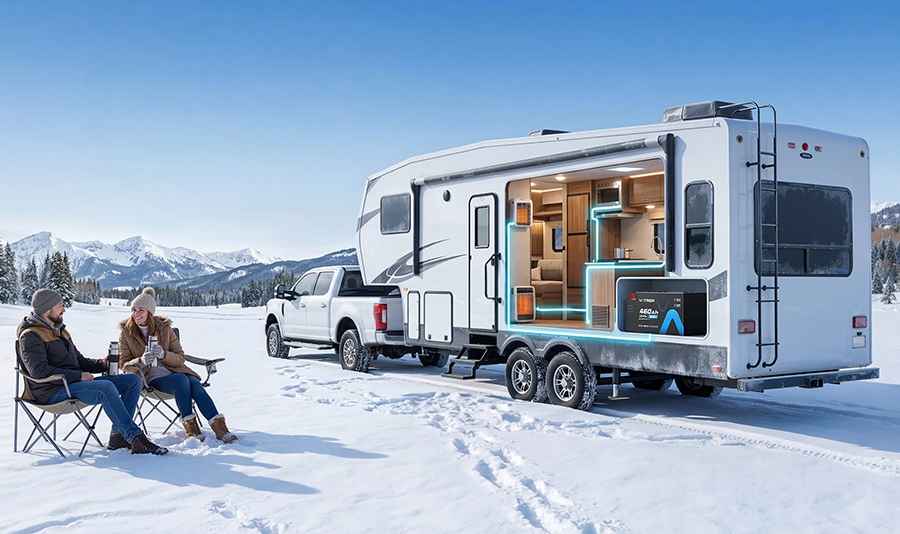
For RV operators travelling off-grid, the power system remains one of the most crucial and essential components of the build. It provides the power for the tools necessary for long-distance travel, including cooling and lighting systems, communication devices, and remote working equipment.
After traversing mountain roads, desert trails, and isolated off-grid camping and travel paths, the conclusion can be reached that it is vital for a reliable power system to have enough capacity and to work under real-life conditions.
This article shows main considerations when planning the power supply for an off-grid RV trip.
Lesson 1: Know Your True Energy Requirements
A common blunder among RV owners is underestimating daily energy needs, specifically when vacationing.
It is important for travelers to know how much electricity they will need; again, they most often require very little in their normal scenario of having a fridge and charging electronics. However, as their trip progresses, there are more gadgets added to their list of necessary electronics. A diesel heater, water pump, lighting system, communication equipment, a computer, digital camera, and so on.
Understanding electricity requirements is an important step before choosing a battery.
A small camping trailer used for a weekend trip may need much less energy than a big motorhome used for a long trip.
Knowing the energy requirement is critical. Someone who only travels with essential gear might do fine with a small battery while someone who travels with add-ons might need a huge energy supply.
It is good to have some extra capacity when going off-road, as the generation of solar power can’t always be predictable due to the geography or bad weather.
Lesson 2: Cold Weather Can Affect Your Battery Performance
Ways of dealing with extreme weather are one of the biggest difficulties with RV power systems.
Most beautiful places are also not easy to get to. Mountains, forests, and places to camp during winter expose your appliances to freezing temperatures.
Travelers with RVs have started using lithium iron phosphate (LiFePO4) batteries because they live longer and are very efficient and dependable. However, regular lithium batteries stop working when the temperature drops to +32°F and the battery will stop discharging at lower temperatures.In order to avoid these problems during cold trips, you can use heated batteries, like Vatrer 12V 300Ah self-heating lithium battery.
Vatrer Power self-heating lithium batteries has the built-in heating function that starts when temperature is at +32°F and allows charging at +41°F, thus ensuring better performance of batteries in cold conditions.
Lesson 3: Select Battery Capacity Based on Your Travel Style
One cannot find a general battery system that fits every RV trip.
Larger batteries allow less frequent charging and give flexibility when off-grid. But higher capacity batteries might need more room, planning and money.
The optimal solution is to match your traveling habits. Weekend travelers using a small camper will have different priorities when choosing battery size compared to those who voyage full-time or work remotely.
Vatrer 12V LiFePO4 series has a range of batteries that suit different off-grid needs.
| Model | Energy | Dimensions | Weight | Best Fit |
|---|---|---|---|---|
| Vatrer 12V 300Ah Self-Heating Lithium Battery | 3,840Wh | 15.12 × 7.64 × 9.76 in 384 × 194 × 248 mm | 54.67 lbs 24.8 kg | Compact RVs, camper vans, and space-conscious builds |
| Vatrer 12V 460Ah Self-Heating Lithium Battery | 5,888Wh | 18.78 × 10.75 × 9.92 in 477 × 273 × 252 mm | 104.7 lbs 47.5 kg | Extended off-grid travel and mid-size RV systems |
| Vatrer 12V 560Ah Self-Heating Lithium Battery | 7,168Wh | 16.69 × 14.8 × 11.14 in 424 × 376 × 283 mm | 136.58 lbs 61.95 kg | Larger RV setups and travelers with higher energy demands |
| Vatrer 12V 600Ah Self-Heating Lithium Battery | 7,680Wh | 25 × 9.61 × 8.66 in 635 × 244 × 220 mm | 107.7 lbs 48.85 kg | Long-duration RV travel and maximum energy storage needs |
Optimizing Your RV Power System for Remote Travel
Another important thing for RV owners is setting up the right battery system for their travels. For example, using two 12V 300Ah batteries can store the same amount of energy as one 12V 600Ah battery, but they are installed differently. Having two batteries offers more flexibility if your RV has limited space. A single large-capacity battery can make wiring simpler and look tidier. No matter how you set it up, a good off-grid system needs both enough storage and the ability to charge.
Most people traveling remotely use solar panels, their vehicle's alternator, and sometimes a generator to keep power up. Because you can't always predict the weather or when you'll have charging opportunities, having extra battery power gives you more options. A good lithium battery system with a reliable Battery Management System (BMS) helps prevent common problems like overcharging, draining too much, or issues related to temperature.
The ideal setup isn't just about having the biggest battery, but a balanced system that fits your RV's space, how you charge it, and how you travel.
The Bottom Line for Remote Road Adventurers
The Main Point for Remote Road Explorers Every remote trip starts with planning, but the real reward is discovering places off the beaten path.
A well-thought-out RV power system gives you the freedom to stay longer, go farther, and visit places away from typical campsites and busy routes.
So get your gear ready, pick your route, and keep exploring. There are many remote roads, hidden landscapes, and unforgettable adventures out there waiting for you.
Learn more: vatrerpower.com