How to drive on periodically flooded roads?
A notable number of tidal roads and flooded causeways exist around the world, although they are not the norm due to the physical and logistical hazards involved. Most of these routes are located in areas with high tidal ranges (such as Northwestern Europe or the Atlantic coast of North America) or in river deltas and floodplains. Before traveling, check the most important flooded roads in the world to identify active crossing hazard zones.
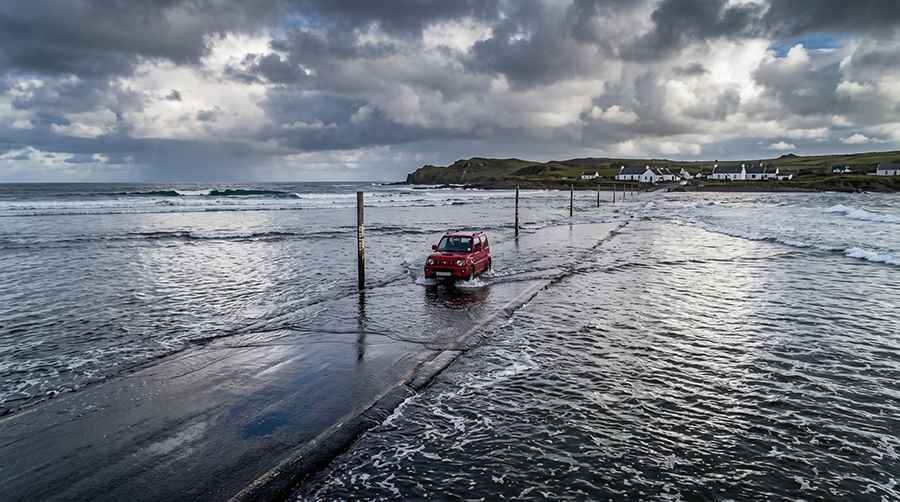
What types of flooded roads exist?
Flooded and submergeable routes generally fall into three structural categories:
- Tidal roads or causeways: Built across seabed or estuaries, these routes go completely underwater twice a day during high tide. Vehicle transit is strictly limited to low-tide windows.
- River crossings or fords: Roads that cross rivers or streams without a bridge. Water flow varies with rainfall or snowmelt, shifting the track from drivable ground to a fast-moving current.
- Seasonal floodplain roads: Routes in tropical or inland zones that remain flooded for months due to seasonal river rises or expanding deltas (such as the Pantanal or the Okavango Delta).
Is driving on flooded roads dangerous for vehicles?
Seawater and fresh water currents destroy a vehicle in two distinct ways: through mechanical failure and through aggressive corrosion.
What are the real hazards when a road floods?
- Water entering the air intake (Engine Hydrolock): If water reaches the height of the air filter, the engine pulls it directly into the cylinders. Because water cannot be compressed like gas, the pistons stop instantly, connecting rods bend, and the engine is destroyed on the spot. Depending on the vehicle, as little as 20 to 30 centimeters of water is enough to cause catastrophic failure.
- Accelerated seawater corrosion: On tidal causeways, salt penetrates undercarriage recesses, brakes, wheel bearings, and electrical connectors. Without an immediate high-pressure freshwater wash, salt oxidizes the chassis and rusts structural piping and bolts within months.
- Buoyancy and traction loss: A standard passenger car begins to float in less than 30 centimeters of water. Once tires lose firm contact with the road, the vehicle becomes a rudderless boat, allowing mild currents to push it off the track into deep water or the sea.
- Immediate electrical failure: Modern vehicles house control modules and sensors in the lower chassis and wheel wells. Saltwater causes instant short circuits and triggers security cut-offs, leaving the vehicle stranded in the path of the rising tide.
- Unstable ground and algae coverage: The exposed seabed or riverbed is often coated in slick marine algae, soft mud, or quicksand. If tires spin or sink even a few centimeters, traction is lost completely before the water rises again.
What precautions must be taken on flooded roads?
Driving through a tidal causeway or flooded crossing leaves zero room for improvisation. These practical measures must be applied on the road:
How to calculate the crossing window and timing?
- Check official tide tables: Verify the exact time of low tide and cross strictly within the recommended safety window (typically between 1 hour and 1.5 hours before and after lowest water).
- Ignore GPS and read road signs: Navigation apps do not account for tides and will route vehicles onto causeways submerged under three meters of water. Physical road signs are the only valid indicator.
- Do not cross if water touches the asphalt: If the tide is rising and reaches the road edge, or if a river current rises above wheel hubs, turn around immediately. Water rises faster than a stuck vehicle can be recovered.
What driving technique should be applied?
- Low gear and constant speed: Enter the water in first or second gear, maintaining a steady, smooth pace without stopping. This pushes a bow wave ahead of the front bumper and prevents water from backing up into the exhaust.
- Keep engine revs up: Abruptly lifting off the throttle drops exhaust gas pressure, allowing water to enter the muffler or catalytic converter.
- Follow the road line strictly: Stay in the center of the track or align with guide posts. Deviating from the marked line drops wheels into drainage ditches, soft mud, or submerged potholes.
- Do not change gears in the water: Depressing the clutch causes loss of momentum and increases the risk of water entering the gearbox or stalling the engine.
What must be done immediately after exiting?
- Dry the brakes: Immediately upon exiting the flooded zone, gently tap the brake pedal several times at low speed to burn off water and restore braking friction.
- High-pressure undercarriage wash: After driving through seawater, power-washing the underbody, wheel arches, suspension, and brakes with fresh water is mandatory to remove salt and prevent rapid corrosion of sheet metal and bearings.