Expedition-Ready Heavy-Duty Truck Build: Engineering Reliability for Demanding Overland Missions
When loaded to GVWR with armor, gear, and an off-road trailer, a heavy-duty Ford, GM, or Ram diesel routinely exceeds 10,000 lbs. Building an expedition-ready rig isn't about chasing peak horsepower—it is about controlling temperatures, ensuring drivetrain reliability, and maximizing self-recovery capability.
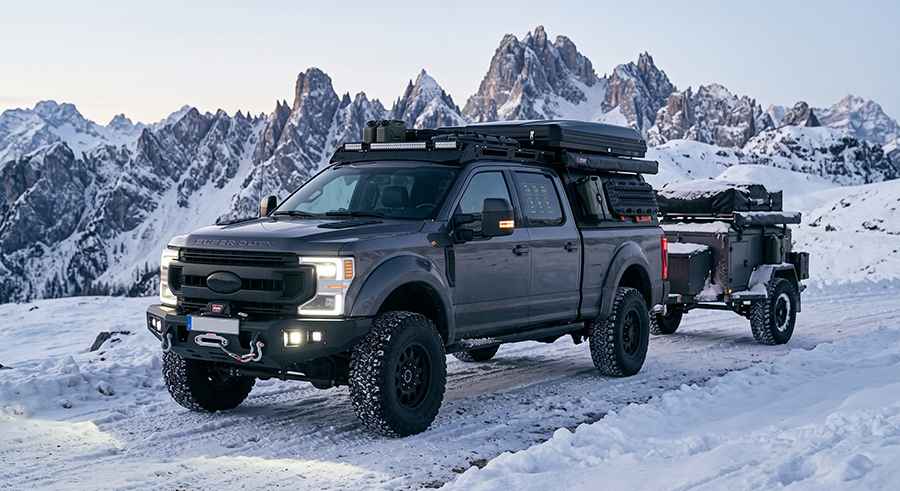
Specialized suppliers like Suncent offer dedicated diesel truck parts and accessories, but every modification should be selected around your platform's specific limits.
Drivetrain Vulnerabilities & Platform Thermal Management
While the Big Three diesel engines produce massive torque out of the box, each platform exhibits distinct bottlenecks during sustained, heavy-load overlanding.
Ford 6.7L Power Stroke: Primary & Secondary Thermal Limits
The 6.7L Power Stroke utilizes a dual-cooling system (a primary high-temp loop and a secondary low-temp loop for the intercooler). Under continuous 6–8% grade climbs with a heavy trailer:
Exhaust Gas Temperatures (EGT): Pre-turbo EGTs can quickly spike past 1,200°F (650°C). Sustained temperatures above 1,350°F risk turbocharger vane deformation and exhaust valve degradation.
Cooling Delta: Monitor the delta between Engine Coolant Temperature (ECT) and Engine Oil Temperature (EOT). A delta exceeding 15°F under load usually indicates oil cooler clogging.
Actionable Fix: Prioritize an upgraded aluminum secondary radiator, a high-flow cold side intercooler pipe to replace the failure-prone factory plastic coupler, and a digital monitor (such as Edge Insight CTS3) set to track pre-turbo EGTs via an expandable EGT probe.
GM 6.6L Duramax (LML & L5P): MAP Sensor Contamination & Thermal Soak
Modern Duramax platforms feature robust internals, but their intake and emission sensor networks require vigilant trail maintenance:
Soot Clogging: The MAP (Manifold Absolute Pressure) sensor is notoriously prone to heavy soot accumulation from recirculated exhaust gases mixed with PCV oil vapor. A caked MAP sensor misreads boost pressure, causing sluggish throttle response and improper fuel delivery.
Transmission Heat: The Allison 6-speed/10-speed transmissions handle high torque well, but fluid temperatures can spike rapidly during low-speed, high-load trail crawls.
Actionable Fix: Pack a dedicated aerosol can of MAP Sensor Cleaner on every expedition and clean the probe every 15,000–20,000 miles. Install a high-capacity transmission pan with cooling fins and an upgraded auxiliary transmission cooler to keep fluid temperatures strictly below 200°F (93°C).
Ram 6.7L Cummins: Low-RPM Heat Dissipation & Intake Deposits
The inline-six Cummins delivers maximum torque as low as 1,600 RPM, making it an ideal rock-crawling and towing engine. However, low-speed trail driving introduces unique heat-dissipation challenges:
Airflow Deficit: Low vehicle speeds mean minimal ram-air effect through the front grille, forcing the mechanical fan clutch to do all the work.
Intake Grid Heater & Horn Restrictions: Intake airflow restrictions and carbon buildup on the intake horn reduce volumetric efficiency over time.
Actionable Fix: Verify fan clutch engagement before trips. Upgrade to a high-flow intake horn and maintain a clean crankcase ventilation (CCV) filter to prevent oily sludge from clogging the intercooler core internally.
Practical Performance Upgrades for Field Reliability
Instead of aggressive performance tunes that elevate cylinder pressures and risk head-gasket failure, focus on airflow efficiency, sensor health, and targeted hardware solutions.
System Focus | Upgrade Strategy | Primary Expedition Benefit |
Airflow & EGT Control | High-flow cast intake elbow & downpipe | Lower EGTs by 50–100°F under load |
Powertrain Monitoring | OBD-II digital gauge (Edge CTS3/Banks) | Real-time ECT/EOT/EGT/Trans Temp tracking |
Transmission Longevity | Deep aluminum pan & heavy-duty cooler | Prevents fluid oxidation & slippage |
Diagnostics | Bi-directional OBD-II scanner | Clears limp-mode DTCs in the backcountry |
Critical Trail Parameters to Monitor Real-Time
Pre-Turbo EGT: Keep under 1,250°F for long-term engine survival.
Transmission Fluid Temp: Ideally between 165°F - 195°F.
ECT / EOT Delta: Should remain within a 15°F margin.
Boost Pressure / Fuel Rail Pressure: Drops indicate boost leaks or fuel filter restriction.
When setting up a dedicated off-road rig, eliminating severe exhaust backpressure and thermal bottlenecks is often top of mind for builders sourcing heavy-duty components from aftermarket brands like Suncent. Selecting a high-grade DPF delete kit can vastly improve exhaust scavenging and lower operating EGTs on dedicated trail platforms. For a comprehensive hardware overhaul, opting for a complete diesel delete kit from Suncent provides an integrated setup designed to solve systemic flow restrictions and enhance long-term engine survival in remote environments.
Trail Geometry, Armor, and Load-Rated Running Gear
Underbody Armor Mechanics
A loaded heavy-duty rig sliding off a rock ledge can crush a thin oil pan or crack a cast-aluminum transmission case in seconds.
Material Selection: Use minimum 3/16-inch steel for high-impact zones (oil pan, transfer case) or 1/4-inch 6061-T6 aluminum for weight-sensitive builds.
Key Zones: Protect the engine oil pan, transmission pan, transfer case, fuel tank, and vulnerable DEF/aftertreatment components if equipped.
Suspension Dynamics & Wheel/Tire Load Ratings
Never compromise on tire load capacity to fit a larger tread profile.
Load Range Ratings: Standard Load Range E tires (3,080–3,750 lbs capacity per tire) are mandatory. For heavily armored HD builds, step up to Load Range F or G where wheel specs permit.
Suspension Lift Height: Cap suspension lifts at 2.5 to 3 inches. Extreme 6-inch lifts alter driveshaft operating angles, induce premature U-joint/CV axle wear, and dangerously raise the vehicle's center of gravity.
Shock Damping: Install 2.5-inch or 3.0-inch remote-reservoir shocks (e.g., Fox, King, or Icon). The external reservoir increases oil volume, preventing shock fade during hours of continuous washboard corrugation.
Heavy-Duty Self-Recovery Math & Trail Execution
Recovering an 8,000 lb truck carrying 2,500 lbs of expedition payload stuck in deep mud requires far more pull capacity than a standard Jeep or Tacoma setup.
The Winch Calculation Formula
Minimum Winch Capacity = Gross Vehicle Weight (GVW) × 1.5
For a fully outfitted Ram 2500 weighing 10,000 lbs fully loaded:
Target Winch Rating = 10,000 × 1.5 = 15,000 lbs
Use a 16,500 lb rated winch equipped with synthetic rope and a heavy-duty forged mounting plate.
Recovery Force Multiplication Tip: Always carry a snatch block. Routing your winch cable through a snatch block doubles effective pulling force (e.g., turning a 16,500 lb pull into a 33,000 lb pull) while halving the current draw on your dual-battery electrical system.
Tire Pressure Management: Deflating 10-ply HD tires from 65 PSI down to 22–25 PSI expands the contact patch by over 40%, vastly improving traction in soft sand and deep silt. Re-inflate using an onboard dual-piston air compressor before hitting pavement.
Backcountry Diesel Field Kit Checklists
Essential Diagnostics & Spare Hardware
OBD-II Diagnostic Scanner: Bi-directional tool capable of reading manufacturer-specific DTCs and initiating manual system checks.
Spare Sensors: Pack an extra MAP sensor, Crankshaft/Camshaft Position sensors, and EGT probe sensors.
Filters & Fluids: 1x main fuel filter set, 1 gallon of recommended engine oil, 1 gallon of pre-mixed coolant, and 1 quart of ATF.
Serpentine Belt & Hoses: Extra serpentine belt, upper/lower radiator hose repair sleeves, and heavy-duty T-bolt clamps.
Final Inspection Protocol
Before departing cell service:
Scan for stored or pending DTCs.
Pressure test the intake charge-air system for hidden boost leaks.
Torque all suspension fasteners, track bar bolts, and U-bolts.
Test winch operation and inspect synthetic line for abrasion.
Verify satellite communicator signal and battery charge.
Conclusion: Building an Unstoppable HD Expedition Rig
An expedition-ready Ford Super Duty, Chevrolet Silverado HD, or Ram 2500/3500 is not built simply by adding horsepower.
Whether sourcing essential maintenance components, specialized lighting, armor, or performance accessories from trusted suppliers like Suncent, every modification should solve a real mechanical bottleneck rather than just add another figure to a spec sheet.
The best expedition diesel is not necessarily the one producing the highest dyno numbers. It is the truck that can climb the mountain under heavy payload, maintain stable fluid temperatures, protect its vital underbody components, recover itself in extreme terrain, and reliably get you back home.
Expedition Build Summary FAQ
Q: Which HD diesel platform is inherently best for overlanding?
A: All three major platforms excel when properly prepared. The Ford 6.7L offers superior factory power and cab comfort; the GM Duramax/Allison setup provides smooth power delivery and highway manners; the Ram 6.7L Cummins offers unmatched low-end torque and a simple inline-six engine bay layout that simplifies field repairs.
Q: Can I run 37-inch tires without ruining my towing capacity?
A: Jumping to 37-inch tires effectively tallies up your gear ratio, straining the transmission and raising EGTs. To maintain factory power bands and towing capacity, re-gear your front and rear differentials (e.g., upgrading from 3.55/3.73 to 4.30 axle gears).
Q: How do I clear a "Limp Mode" engine condition on the trail?
A: Connect your bi-directional OBD-II scanner to identify the trigger code. Common culprits include boost leaks, faulty EGT sensors, or a heavily soot-caked MAP sensor. Address the mechanical root cause (e.g., spray-clean the MAP sensor or tighten a loose intercooler boot) before clearing the code.