The Hidden Risks of Using Autopilot on Winding Mountain Passes
Mountain roads are breathtaking, but they're also some of the most punishing environments a driver-assist system will ever face. Winding passes throw everything at a car at once: steep grades, blind corners, faded lane markings, loose rock, narrow shoulders, and weather that flips from sunshine to whiteout in a single mile.
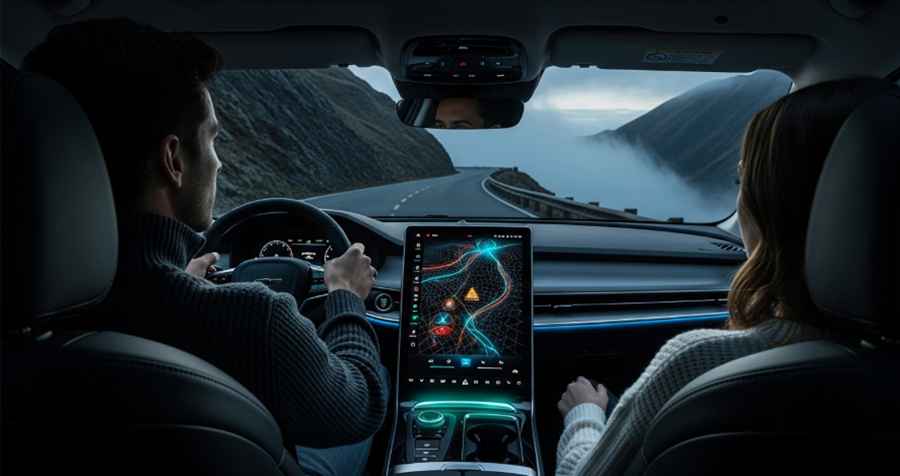
A feature that feels buttery smooth on a divided highway can turn uncertain, delayed, or flat-out confused on a switchback carved into a cliff. If you've ever white-knuckled it through a tight mountain hairpin and wondered whether a computer could handle this, you're not alone. Public skepticism reflects this instinct; 66% of U.S. drivers are afraid of fully self-driving vehicles, and another 25% aren't sure how they feel.
The gap between high-tech capability and raw, unforgiving geography gets painfully obvious on a narrow alpine route. A 2024 Brookings survey found that 93% of U.S. consumers have concerns about some aspect of self-driving cars, with safety and potential technology malfunctions topping the list. When you put a semi-autonomous vehicle on a guardrail-free ledge hundreds of feet above a valley floor, you're trusting sensors built primarily for predictable freeways to handle an environment that's anything but.
What Makes Autopilot on Winding Mountain Passes So Dangerous?
Faded Lane Markings and Missing Guardrails
Most mountain roads don't look anything like the clean, well-marked highways where driver-assist systems perform best. Lane-centering works by interpreting visible lines and predictable road edges through outward-facing cameras. On a mountain pass, that lane paint is frequently faded, partially buried under gravel, washed out by storms, or gone entirely. Picture a road like Beartooth Pass in Montana or the Million Dollar Highway in Colorado; long stretches where the only "line" is the crumbling edge of asphalt meeting dirt.
The absence of guardrails removes a critical physical and visual boundary that sensors rely on to map the driving path. Without a clear painted line or a metal barrier reflecting radar signals, optical systems can struggle to define where the road actually ends. That limitation raises the real risk that the vehicle might drift toward a drop-off or cross the centerline into oncoming traffic.
Sharp Switchbacks and Blind Corners
The geometry of a mountain road poses a severe challenge for forward-looking sensors. Tight hairpins compress available reaction time, forcing the vehicle to process a sudden change in trajectory that a gentle highway curve would never demand. A system programmed to expect smooth, gradual curvature can handle abrupt switchbacks poorly, often requiring human intervention earlier than a driver might anticipate. If you've ever driven Stelvio Pass in Italy or Trollstigen in Norway, you know these turns can feel borderline impossible even with full manual control.
Blind corners further restrict the operational view of both cameras and radar. Solid rock faces, dense pine trees, heavily cut slopes, and dark tunnel entrances physically block the sensors' line of sight. When the software can't detect what's beyond a mountain wall, it can't prepare for an oncoming logging truck or a stalled vehicle just around the bend. Sound familiar? Ask anyone who regularly drives high-altitude passes, and they'll tell you the same thing: surprises are the rule, not the exception.
Steep Grades Distort Speed, Braking, and Sensor Confidence
Mountain driving challenges more than just steering; it drastically alters the vehicle's physics. Uphill and downhill grades directly affect stopping distance, weight transfer, and tire traction. Driving from Denver to Vail already demands intense manual concentration due to severe elevation changes, and layering automated speed control on top of that can make things worse rather than better.
When a vehicle crests a steep hill, the sudden pitch change may temporarily point the front cameras and radar upward, cutting their view of immediate hazards on the pavement below. Think of it like tilting binoculars toward the sky when you should be watching the trail ahead. On a steep descent, gravity forces the braking system to work harder, and even a brief delay in automated response can lead to a dangerous buildup of momentum that's tough to claw back.
Unpredictable Infrastructure
Roadwork and structural maintenance on mountain passes regularly create temporary, confusing traffic patterns. Temporary barriers, narrow pullouts, rockfall debris, and unmarked pavement edges routinely force drivers out of standard travel lanes.Tesla's unredacted robotaxi records describe incidents involving fixed roadside objects such as fences, curbs, poles, and barricades, illustrating how automation can struggle with irregular infrastructure that doesn't match its training data.
Unexpected obstacles add yet another layer of complexity: touring cyclists grinding up a grade, stray wildlife crossing at dusk, or hikers standing in the road snapping photos. While a human driver can instantly recognize that a dirt shoulder isn't a travel lane, a camera interpreting a faded white line may steer the vehicle straight toward a roadside ditch. And yes, there's a catch; by the time the system figures out its mistake, you may already be off the pavement.
Weather Changes That Arrive Without Warning
Mountain weather is notoriously volatile, capable of shifting from dry pavement to zero-visibility fog within a single mile. Heavy rain, sleet, blinding sunlight, and unexpected snow patches directly interfere with a vehicle's sensor array. Forward-facing cameras can be knocked out of commission by sudden glare or the stark contrast of dark cliff shadows stretching across the road.
As precipitation falls, sensor performance degrades because water, dust, and dirty ice coat the lenses and radar surfaces. Human drivers reason contextually. You see dark clouds piling up over the next ridge and instinctively ease off the gas. Automated systems can only process the degraded inputs they're receiving right now, with no ability to look up and think, "this is about to get ugly."
Driving Condition | Why It Challenges Driver-Assist Systems | Risk to the Human Driver |
Faded lane markings | Lane-centering may lose visual reference | Drift toward shoulder or centerline |
Sharp switchbacks | Abrupt curvature reduces reaction time | Late takeover or overcorrection |
Steep descents | Pitch changes and braking demands alter vehicle dynamics | Speed buildup or unstable control |
Fog, glare, or snow patches | Cameras and sensors receive degraded input | Missed hazards |
Construction or rockfall debris | Unmapped obstacles confuse path prediction | Sudden swerves or hard braking |
Why Mountain Terrain Exposes the Limits of Today's Driver-Assist Systems
So far, you've seen how specific hazards (faded markings, switchbacks, steep grades, infrastructure chaos, and volatile weather) each create problems for automation. But there's a bigger picture here that's worth stepping back to see.
Most Consumer "Autopilot" Systems Aren't Truly Self-Driving
You need to understand the exact technical classification of the technology running your car, because the branding is misleading. Tesla Autopilot and similar systems from other manufacturers are classified as Level 2 driver-assist features. That means you, the human driver, must supervise continuously and remain legally responsible for the vehicle's behavior at all times.
These systems aren't fully autonomous, regardless of what the marketing copy suggests. Running a Level 2 system on a mountain pass actually demands more vigilance, not less, because you have to constantly anticipate when the software might suddenly disengage or make an error. It's the worst of both worlds if you're not paying attention: enough automation to make you comfortable, not nearly enough to keep you safe.
Sensors Don't "Understand" the Road the Way You Do
Modern vehicles rely on a suite of hardware to interpret their surroundings, but they lack anything resembling human intuition. Cameras detect visible lines, road edges, and signs, while radar estimates movement and distance by bouncing radio waves off objects. The software then processes this data to predict a lane path. It's sophisticated, but it's also brittle in unfamiliar conditions.
Mountain roads create visual ambiguity that can fool these systems in ways you might not expect. A dark cliff shadow may look identical to a lane edge through a digital camera's lens, while a sheer rock wall can obscure the geometry of the upcoming road. Snowbanks and gravel shoulders can also confuse pathing software, resulting in sudden steering adjustments that feel jarring (or worse, send the car in the wrong direction entirely).
Recent Crash Reporting Shows the Industry Still Struggles With Edge Cases
The transition from controlled testing environments to messy, real-world roads continues to produce concerning results. In one incident, a Tesla on Autopilot crashed into a home in Claremont, injuring six people, including a child, while the cause remained under investigation. In another case, a fatal Florida crash involved a Tesla reportedly using Autopilot that left the roadway and entered water, adding urgency to the conversation around driver supervision and system reliability.
These aren't hypothetical scenarios cooked up in a lab. They're real crashes on real roads, and they underscore just how quickly a driver-assist system can fail when conditions deviate from the norm. Not where you expected a road safety article to go? That's kind of the point.
The Data Is Mixed, Which Makes Overconfidence Even More Dangerous
Evaluating the safety of self-driving features means looking at competing datasets, since performance varies widely across driving environments. NHTSA-related crash data highlighted by legal experts indicates that self-driving cars recorded 9.1 accidents per million miles traveled, compared to just 4.2 for traditional automobiles. This discrepancy suggests that specific automated driving systems may falter when operating outside optimal environments.
On the other hand, Waymo's 2024 safety study covering 7.1 million miles found an 85% lower rate of injury crashes compared with a human benchmark. But here's the critical distinction: a winding mountain pass is a radically different environment from a highly mapped urban fleet zone or a dry, straight freeway. Treating mountain terrain with the same confidence you'd bring to a city grid is a dangerous miscalculation, and the mixed data should make you more cautious, not less.
Where Human Drivers Still Matter Most
Moments That Demand Immediate Human Control
On a road cut into stone with severe drop-offs, human intervention is the primary safety layer. Manual control bypasses sensor latency, allowing you to react instantly to visual threats that a camera might take a second or two to process.
Take over immediately if you encounter any of the following:
Faded or missing lane markings, especially on exposed cliff sections
Tight switchbacks or blind hairpins where forward visibility drops to near zero
Steep descents requiring careful, deliberate brake modulation
Construction zones or temporary barriers that reroute traffic unpredictably
Snow patches, fog, heavy glare, or falling rock (basically any active weather or debris hazard)
Cyclists, hikers, animals, or stalled vehicles are anywhere near the roadway
Mountain Driving Requires Judgment, Not Just Detection
Human drivers possess something that software can't yet replicate: the ability to interpret geographic and social context. You understand how to read shifting mountain weather, and you can anticipate what a heavy truck is about to do when it crosses the centerline on a tight curve. That kind of reasoning isn't programmed into a Level 2 system.
You can instantly recognize that a narrow dirt turnout is meant for yielding, not for active travel. More importantly, human judgment tells you when a speed might be technically legal according to the posted signs but still unsafe for current road conditions. If you've ever driven a 25 mph switchback in rain and thought, "even 25 feels too fast right now," you've exercised exactly the kind of contextual awareness that automation lacks.
Why Complacency Is the Real Hazard
The smoother automation feels on an easy stretch of highway, the easier it becomes to trust it in the wrong place. On gentle roads, competent lane-centering can lull you into overtrust, stretching the time it takes to retake the wheel in an emergency. You've probably experienced this if you've ever zoned out on a long interstate drive and then snapped back to attention when the road got interesting.
On dangerous mountain roads, a delayed takeover isn't a minor oops. It can be catastrophic. An automated system can appear perfectly competent and stable right until the moment the environment becomes too ambiguous for its cameras and software to process safely. The transition from "this is fine" to "this is very wrong" happens in a heartbeat.
When an Autonomous Driving Failure Causes Injuries
Fault Isn't Always Obvious After a Crash
When an accident involves driver-assist technology, figuring out who's actually liable gets complicated fast. The human driver may have over-relied on the system and failed to supervise the road. At the same time, the vehicle owner may share responsibility for ensuring the car's maintenance and software updates are up to date.
The manufacturer could face scrutiny if the hardware design failed or if the sensors were flat-out inadequate for the terrain. The software developer can also be pulled in if the code misidentifies an obstacle or if the system's warnings aren't sufficient to alert the driver in time. So who's at fault? Often, it's a combination of all of the above.
Why Preserving Digital Evidence Matters
Modern vehicles function as rolling computers, constantly generating telemetry that becomes vital after a collision. Event data recorders capture precise pre-crash information, including speed, braking force, and steering angles. Camera footage, sensor logs, and software version histories can help establish what the vehicle detected versus what the driver actually saw.
After crashes involving driver-assist technology, questions about fault often turn on these logs, software histories, and dashboard warnings. Resources covering accidents involving self-driving cars can be useful for understanding how liability gets evaluated in these scenarios. Collecting mobile app notifications, scene photos, and witness statements also helps ensure the digital record aligns with the physical reality of the crash.
Responsibility May Be Shared
Keep in mind that a traffic fault assigned by a highway patrol officer and civil liability aren't always the same thing. Multiple parties can contribute to a single crash, meaning product liability and driver negligence theories can overlap in court. It's rarely a clean, single-cause situation.
This becomes especially complicated when a human is legally expected to supervise the vehicle, but the software's sudden or unpredictable behavior also contributed to the loss of control. Analyzing faults in these cases often requires a detailed technical review of the vehicle's automated decision-making, which can take months.
So, Should You Use Autopilot on a Mountain Pass?
Treat It as Assistance, Not Authority
For winding mountain roads, driver-assist technology should never replace full human attention. The hardware is designed to ease fatigue on predictable highways, not to navigate extreme geographic conditions where every curve hides a potential surprise.
If the road markings are poor, the corners are tightening, the weather is shifting, or the drop-offs are severe, the safest move is to drive manually. Treating the technology as an authority in an unpredictable environment is an unnecessary gamble with your safety, full stop.
A Beautiful Road Can Turn Harrowing in Seconds
Mountain passes remain unforgettable, spectacular journeys that draw millions of drivers every year. But they're fundamentally unforgiving environments that punish slow reaction times and poor judgment without mercy.
Sheer cliffs, loose rocks, and blinding sun glare don't care about branding or marketing promises. Your hands on the wheel and your eyes scanning the road still matter more than any line of software code. That's true today, and it'll stay true for a long time.
The Final Word Before the Climb
The gap between advanced driver-assist technology and real-world mountain terrain remains significant. Automated systems can help manage driver fatigue on long, straight interstate drives, and they do that job reasonably well. But winding mountain passes are a different beast entirely, an environment where human judgment still dominates. On a road cut into stone, with no shoulder and no second chance, the most important safety system in the car is still you.