Essential Guide to Planning Your First Motorcycle Road Trip
More riders are hitting longer routes than ever. Not because of any viral moment or industry trend — just because the roads exist, the bikes keep getting better, and somewhere between cabin fever and rising fuel costs, people started paying the highway actual attention. This guide covers what matters before you leave: gear, route logic, legal basics, and insurance most riders overlook. All of it, one place.
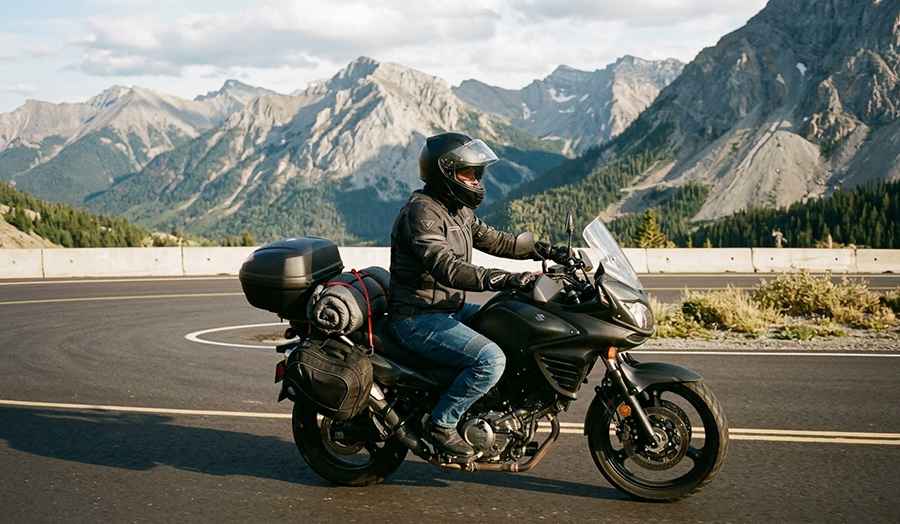
What Gear You Actually Need
Start with the helmet. Full-face or modular — that's the real decision in 2026. Open-face looks good in photos. It also introduces your chin to asphalt at 55 mph. DOT/ECE-certified full-face, or a modular if eating a gas station sandwich with the visor down bothers you.
Jacket next. Mesh breathes in summer heat. Textile handles more seasons. Leather absorbs impact better than both, but it's suffocating by hour six in Arizona. CE Level 2 armor at the shoulders and elbows, minimum. No certification listed on the tag? It's decoration.
Gloves and boots are what riders skip until they have a reason not to. Hands go down first in a fall — every single time. Gauntlet-style gloves with knuckle protection. Boots: ankle coverage, stiff sole, oil-resistant grip. Not a motocross boot. Just actual footwear.
Pants are the forgotten layer. Draggin', Rokker, Bull-It — brands that build CE-rated armor pockets into riding jeans. Not cheap. Cheaper than skin grafts.
One thing worth saying plainly: gear doesn't prevent accidents. It manages consequences. That distinction matters when you're deciding whether the extra $200 for armor is worth it.
How to Plan a Route Without Over-Engineering It
Pick a destination first. Work backward from there.
The mistake most first-timers make is mapping every mile before departure. Sounds responsible. What it actually produces is a logistics exercise — and then a detour that looks interesting gets skipped because the schedule says otherwise.
A better approach: anchor points. Where you sleep night one, where you want to be by day three, what's worth seeing between. Leave the middle open.
A few US routes hold up well for first trips. US-50 across Nevada — brutal, empty, rewarding. Highway 1 down the California coast is crowded in peak summer but genuinely something else in late September. The Blue Ridge Parkway in Virginia and North Carolina offers no trucks, no billboards, a 45 mph limit, and views that stop making sense. The goal is variation — elevation changes, scenery that shifts, towns with character — not just mileage.
Daily distance: 200–250 miles sits comfortably for most new long-distance riders. Beyond that, fatigue sets in without announcing itself. Fatigue is where judgment quietly goes wrong.
The Legal Layer: What Happens If Something Goes Wrong
This section is boring. Worth reading anyway.
Riding in California — and many first big trips start or pass through California — means understanding what happens after an accident that wasn't your fault. Insurance companies move at their own pace. At-fault drivers sometimes carry minimal coverage. Motorcycle injuries at equivalent speeds are typically more serious than car crash injuries. The math doesn't favor the rider.
That's where a California motorcycle accident attorney becomes genuinely relevant — someone with specific motorcycle injury experience who knows how to document losses, counter lowball settlements, and navigate the claims process before it gets away from you. Worth knowing before the need arises.
Across other states: check lane-splitting legality before you go. California allows it; most states don't. Getting a ticket in Utah because the rules changed at the state line is preventable.
Helmet laws: mandatory in 19 states plus DC as of 2026. Even where there's no mandate, wearing one isn't optional if the plan is to have opinions about things going forward.
Bike Prep: What Actually Fails on Long Trips
Tires first. Tread and inflation before departure. A nail in the rear tire at mile 600 in Nevada isn't hypothetical — it happens. Carry a plug kit. Watch how to use it before you need to.
Chain: clean and lubed. Can't remember the last time it got attention? Do it now. A dry chain loses efficiency, then fails. That's a tow truck situation.
Fluids: brake, coolant, oil. Boring to check. Expensive to ignore.
Lights: test headlights, brake light, and turn signals the day before leaving. One dead brake light in a state with mandatory checks can turn a routine stop into a citation.
Pack light. Obvious until everything you "need" is laid out on the floor. Heavy items go lowest and closest to the centerline. A week-long trip fits in two or three days of clothes plus rain gear, tools, and first aid.
Weather, Communication, Navigation
Don't trust apps more than clouds. Forecasts give probabilities. Mountain terrain, desert afternoons, and coastal mornings do what they want. Pack rain gear regardless of what the screen says.
Rain gear means a two-piece waterproof shell that fits over riding gear. Not a poncho. Ponchos turn into sails at speed. A sail on a motorcycle is not useful.
Navigation: mount the phone with a vibration-dampening handlebar mount — prolonged vibration destroys phone cameras, a documented issue on several bikes. Scenic routes motorcycle-specific navigation around highways when told to. Offline maps for remote sections aren't a nice-to-have. They're required.
Insurance: The Section Most Riders Skip
Standard motorcycle insurance covers liability and, with add-ons, your own injuries and bike. What rarely gets added — until after it's needed — is uninsured/underinsured motorist coverage.
The scenario: someone hits you, they're at fault, their coverage is minimal or nonexistent. A standard policy doesn't automatically fill that gap. Medical bills and lost wages land on you. That's what UM/UIM coverage is for. Before renewing, it's worth understanding what is UM insurance and what it actually covers in your state. The coverage is usually inexpensive to add. The absence of it, post-accident, is not.
For multi-state trips: confirm the policy covers every state on the route. Most do. The ones that don't don't advertise it.
The Day Before You Leave
Check tire pressure, chain tension, fluids, lights.
Pack rain gear on top, tools where they're reachable, phone charger inside a pocket.
Tell someone the route. Not dramatically — just a text. "Denver to Moab, back Sunday." If something goes sideways and contact drops, someone should know which road to start looking at.
Sleep. Fatigue on a motorcycle isn't a metaphor. Reaction time drops, lane position drifts, threat detection slows. A rested rider on a mediocre bike is safer than an exhausted one on a great bike. No exceptions.
Final Thoughts: Why the First Long Trip Is Different
The first long trip changes something — not because it's supposed to, but because it actually does. Being physically present in a place rather than passing through it in a climate-controlled cabin is a different experience. Hard to explain before doing it.
Go find out.