Run for the Wall: A Rider's Account of the 2,800-Mile Memorial Pilgrimage
Riders describe the first morning of Run for the Wall the same way. A parking lot in Ontario, California, before sunrise. The smell of hot exhaust and coffee. Engines that have not stopped idling.
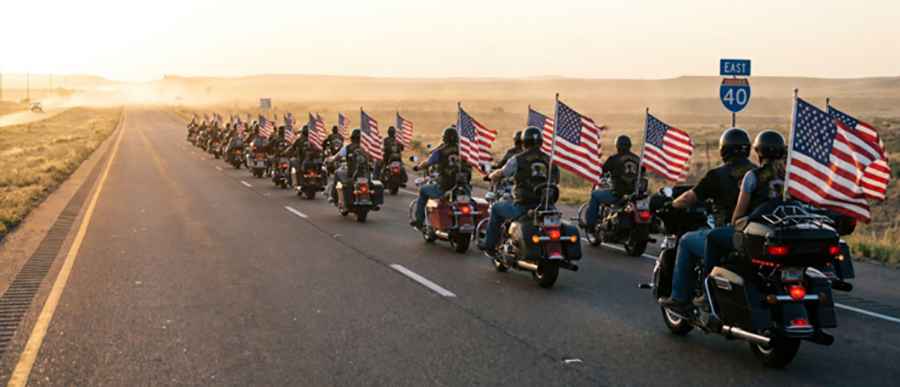
Riders in cuts and vests, some patched edge to edge with route rockers and chapter insignia, some with a single embroidered POW/MIA panel sewn over the heart. The crowd grows quiet when an older veteran reads the day's mission statement aloud. Then more than a thousand motorcycles roll out together, a procession that will move east across nine states until it reaches the black granite Wall in Washington, D.C.
This is Run for the Wall. By most counts, it is the largest organized veteran motorcycle ride in the country, and one of the few road events in the United States that still moves like a military operation.
How It Starts
Run for the Wall began in 1989, when two Vietnam veterans, James "Gunny" Gregory and Bill Evans, decided to ride coast to coast to draw attention to the prisoners of war and missing in action who had still not been accounted for. The first ride was small, around twenty motorcycles. Recent editions have drawn more than a thousand riders across three concurrent routes, Central, Southern, and Sandbox, all converging on the National Mall over Memorial Day weekend.
The mission has not changed much. According to the official ride organization, the purpose is to promote healing among veterans, call for a full accounting of all POW/MIA, honor those killed in action, and support active military personnel. Riders refer to the trip simply as "the Run." The Central route, which begins in Ontario, runs about 2,800 miles and takes ten days, climbing east through the high desert and following long stretches that parallel the historic Route 66.
The Pace
Riders are organized into platoons of twenty to thirty bikes, with road guards, chase trucks, and a mobile chaplain attached. The pacing is deliberate and slower than most riders are used to. There is no passing within the formation. There is no stopping unless the road captain stops. Hand signals move down the column for fuel, for debris, for a slow vehicle ahead.
Most days begin around 5:30 in the morning and end with a community dinner at a VFW or American Legion hall in whatever town has agreed to host that evening. The day's miles are not the test most riders expect. The test is the discipline. Holding a tight formation in summer crosswinds for ten hours a day is a different kind of work than weekend riding. Most riders sleep where they can. Some bring tents. Many sleep on the floors of fire stations and churches that open their doors year after year.
Small-Town America
The towns are the part of the trip that surprises first-time riders, who are called FNGs, short for First-N-Goers. In Limon, Colorado. In Cuba, Missouri. In Wentzville. In Corydon, Indiana. People line the off-ramps with flags. Schoolchildren are let out of class to wave. Veterans in wheelchairs are wheeled to the curb to salute the formation as it passes.
In some towns, the police escort comes from three counties over. In others, the entire fire department turns out with the engine pulled across the road and the ladder raised so the formation rides under the flag. None of this is staged. It happens because the ride has been passing through on these backroads and old federal highways for thirty-five years, and the towns have decided that it matters.
Patches, Pins, and the Things You Carry
Riders trade patches and pins at every stop. State patches. Mission patches. Memorial patches with the name of someone the rider is carrying. By the end of the ride, a first-timer's vest looks completely different from what it did in Ontario. The patch culture is its own quiet economy. Most are stitched by small custom shops. Many riders order their own personal patches, often embroidered patches commemorating a unit, a fallen friend, or a private dedication, and bring extras to give away.
The exchanges happen in fuel station parking lots and at evening dinners. Someone presses a patch into your hand. You hand them yours. There is usually a story attached, and sometimes the story is the only payment offered or asked.
The Last Mile
The arrival in Washington happens on the Friday before Memorial Day. The formation enters the city escorted by police motorcycle units from multiple jurisdictions, with traffic stopped at intersections and crowds along the bridges. Riders dismount near the Mall and walk the rest of the way to the Wall on foot. Many are carrying something. A photograph. A letter. A patch with a name.
The Vietnam Veterans Memorial holds the names of more than 58,000 Americans killed or missing in the war. According to the Department of Defense POW/MIA Accounting Agency, more than 1,500 service members from the Vietnam War remain unaccounted for. For Run for the Wall, the unaccounted is not a historical category. It is the reason the ride exists.
What Stays With You
Riders who finish the Run often describe it the same way. The ride was harder than they expected and shorter than they wanted. The small towns are what they remember most clearly, more than the Wall itself, though the Wall is what stays the longest.
For most riders, it is not a typical tourist trip. It is a pilgrimage, organized like a military operation, that moves at the speed of a motorcycle convoy across a country that for ten days a year remembers something it usually does not. The patches come home. The miles do not.