What Happens After a Serious Crash on a Remote Road?
There are numerous reasons riders seek out the farthest of roads, those that resemble no more than strips of tarmac clinging to the side of a mountain. Whether it’s a coastal stretch with a hint of sea spray in the air and no traffic lights for miles, or a high pass with every hairpin bend demanding total concentration.
These are the types of rides that test your line choice, throttle control, and your nerve! Hitting a straight on one of these tracks feels like just reward for what’s gone before.
These roads make you forget all about the tedium of commuting, that’s for sure.
Instead, they’ll provide you with a lifetime of memories.
But they are also unforgiving, and one error can be all it takes for the trip of a lifetime to become the road from Hell.
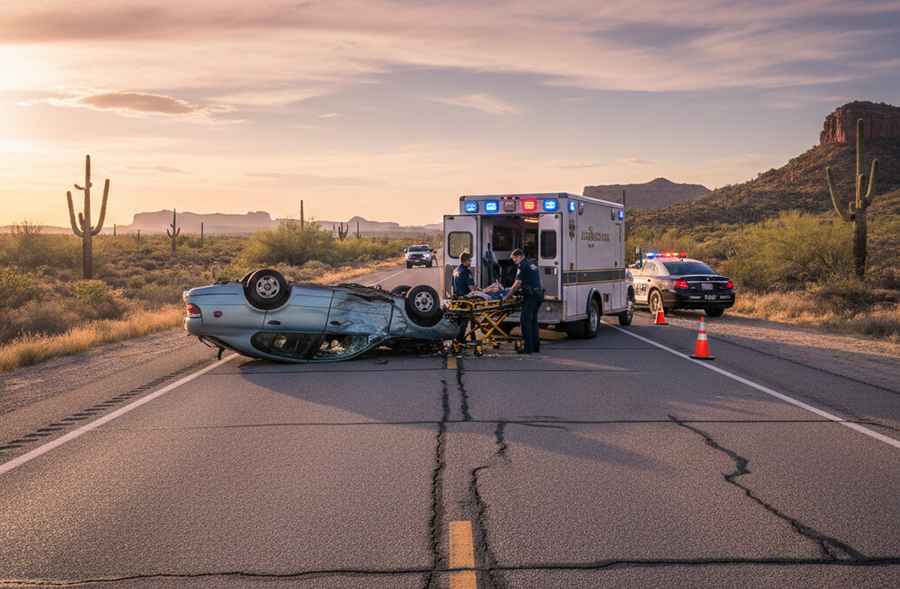
And when a serious crash happens miles from anywhere, the story changes fast.
When the Ride Stops Suddenly
On isolated roads, you are on your own. Help isn’t waiting around the corner.
Ambulances may need to come from afar. Rescue crews have to navigate the same blind bends and uneven surfaces that may have contributed to the accident you were involved in. In mountainous regions, air rescue often becomes necessary.
For motorcyclists, the time between an accident and the arrival of first responders can be critical.
A rider thrown from a bike on a tight downhill hairpin lacks the protection of a motor vehicle. Even with full gear, high-speed accidents can cause brain trauma, spinal injury, or internal bleeding. In such situations, a rapid emergency response is essential.
However, on far-flung roads, response times will not be quick, even with the best intentions. Add to the mix a patchy signal, and barely a kilometre marker in sight, and even calling for help becomes a challenge!
Five minutes earlier, the area's remoteness added to the exhilaration. Right now, it feels like your worst enemy.
Why are injuries from accidents on remote roads usually severe?
To answer the question, consider how these environments increase challenges for riders.
They almost invariably feature:
- Tight hairpin bends with only limited visibility.
- No ‘guardrail-protected’ sheer drops
- Unstable road surfaces, with gravel or loose rocks left by rockfalls
- Diesel spills
- Ever-changing weather temperatures
- Wildlife stepping onto the road out of nowhere.
For motorcyclists, changes in the road surface can cause disaster. If a heavily laden touring bike hits a patch of loose gravel, it can end the rider’s trip there, and then. A misjudged overtaking manoeuvre on a narrow ridge road that leaves the biker with nowhere to go could end tragically.
Crashes on these routes often involve much higher speeds than those in urban areas. You could say they are high-impact, high-consequence accidents.
Common serious injuries resulting from these types of accidents include:
- Traumatic brain injuries
- Spinal cord damage
- Multiple or complex fractures
- Severe lower limb injuries
- Damage to internal organs
- Fatalities
What happens in the aftermath of an accident on a remote road?
The crash scene on a remote mountain pass bears little resemblance to one on the local High Street. While both urgently require paramedics, ambulance, police, and fire services, that’s where the likeness ends.
On a remote road, the bike may have left the carriageway entirely; rider and machine might end up on a slope below, if lucky. Sometimes, specialist equipment is needed just to reach the casualty safely.
Evacuating injured persons from difficult-to-access accident scenes by air ambulance is more common in remote areas.
Even after rescue, the nearest hospital may not be equipped to deal with major trauma injuries. In that case, patient stabilisation will be the first priority at the local hospital, with subsequent transfer to a larger trauma centre.
What happens if you are injured whilst overseas?
Motorists and riders travel the world just to ride or drive on some of the legendary stretches of road featured on dangerousroads.org. If you are a seriously injured victim of an accident on one of these roads and you are in a different country when it happens, there’s another layer of difficulty to be overcome.
A different country brings different insurance regulations, road traffic laws, and legal systems. If another party was likely responsible for the accident, questions about liability and compensation become more complicated, especially across borders.
If poor road conditions, such as loose debris, are present and likely contributed to the accident, the situation can become even more complex.
Medical repatriation after a serious crash isn’t simple either. A great deal of organisation goes into getting a severely injured person moved from one country to another. The cost is huge, too, but hopefully it will be covered by the patient’s insurance.
The long road back after the crash
In the case of serious motorcycle crash injuries, recovery rarely ends when you’ve been allowed home from hospital. Physical recovery can take many months - even years.
Multiple surgical interventions and long-term physiotherapy are common. Lower-limb injuries can impair balance and mobility for years, and spinal injuries can cause permanent life changes.
Then there’s the psychological aspect. Surviving a serious crash, which could have been fatal, can result in PTSD and other disorders, especially after high-impact collisions, like the ones described here.
The road to recovery may indeed be a long one.
What if it happens to me?
No one sets out expecting an accident. We ride with the skill and care required every time. On remote, dangerous roads, our focus must be heightened tenfold.
If the worst happens, remember to do the following:
- Try to get yourself out of immediate danger (if you can do so safely).
- Call the emergency services straight away.
- Use any kilometre markers, landmarks or GPS coordinates to ascertain and describe your location to the authorities.
- Photograph road conditions, especially debris, surface issues or missing barriers.
- Exchange details with any other parties involved.
- Get checked over by a medical expert, even if you think you‘ve escaped with a scratch! Concussion, internal bleeding and spinal injuries don’t always reveal their symptoms straightaway.
- Once you are well away from the scene, don’t forget to notify your insurance.
Respect the road - and the risk!
The roads that make the best stories are often the ones shaped by extreme landscapes. Mountains. Cliffs. Deserts. Coastlines. Remote roads are totally worth riding. Understanding what can happen when things go wrong is simply part of travelling wisely.