What are the 5 most common road hazards for motorcyclists?
Riding a motorcycle on technical roads is a constant game of reading the surface. Unlike a car, where a patch of gravel is just a noise in the wheel well, on a bike, it’s a direct threat to your balance. When you’re leaning into a hairpin at 2,000 meters, you aren't just fighting gravity; you're fighting the grip of two tiny patches of rubber. If you don't know how to spot a hazard before your front tire hits it, the road will decide your trajectory for you.
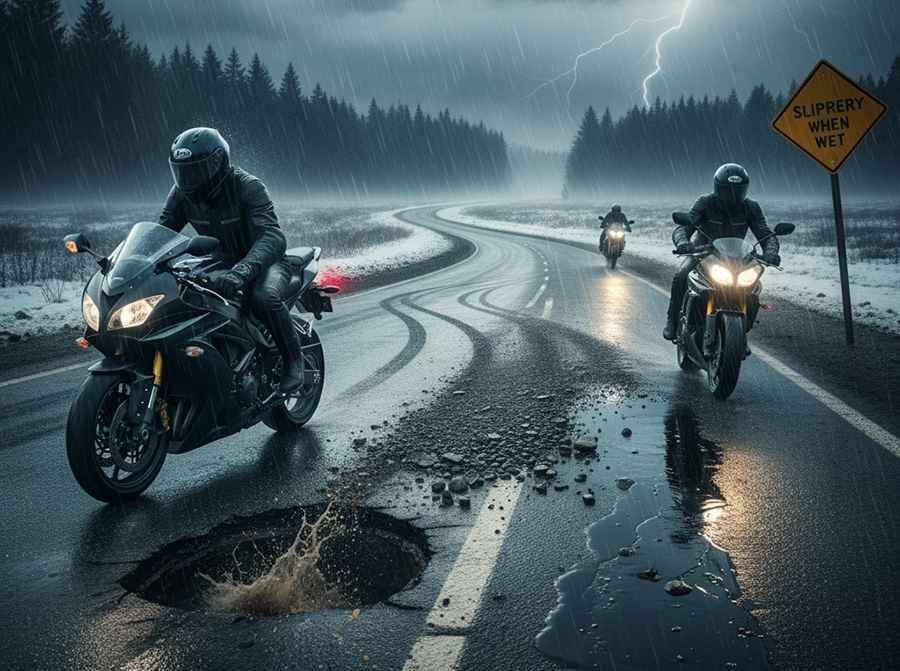
| Motorcycle Hazard Quick Guide | |
|---|---|
| Gravel & Debris | The "front-end killer" in rural bends and construction zones |
| Slick Surfaces | Wet paint lines, manhole covers, and tar snakes |
| The "First Rain" | Oil and dust mix into a grey slime that offers zero grip |
| Potholes | Can bend rims or cause immediate tank-slappers |
Why is gravel the biggest danger for motorcyclists?
Gravel is the ultimate enemy because it’s often invisible until you’re committed to the turn. On mountain roads or near rural farm tracks, trucks often kick up loose stones into the apex of the curve. If your front tire hits a patch of "marbles" while you're leaning, the bike will wash out instantly. The trick isn't just "slowing down"—it’s looking through the turn. If you see a change in the road color or texture, keep the bike as upright as possible and avoid any sudden braking. Let the bike roll through the mess before you get back on the gas.
How do wet road markings affect motorcycle grip?
In the dry, a white line or a manhole cover is fine. In the wet, they are as slippery as a sheet of ice. These "tar snakes" (the rubbery sealant used to fix cracks in the asphalt) and painted arrows have zero porosity, meaning water sits on top and creates a lubrication layer. If you cross a wet pedestrian crossing or a center line while accelerating or braking, the rear tire will spin or the front will lock. Always try to "square off" your path over these bits—cross them with the bike vertical and the throttle steady.
What happens during the first rain on a mountain road?
The most dangerous time to ride isn't during a heavy downpour, but in the first ten minutes of a light drizzle after a dry spell. Months of leaked oil, diesel, and fine dust sit in the pores of the asphalt. When the water hits it, it floats all that grime to the surface, creating a grey, soapy slime. It’s an invisible slick that can't be cleared by your tire tread. If you see bubbles forming on the road surface, your grip is gone. Pull over and wait half an hour for the rain to actually wash the road clean before you continue the climb.
Can potholes cause a motorcycle crash?
For a car, a pothole is a bump; for a bike, it’s a potential disaster. Hitting a deep hole at speed can compress your suspension so hard it bottoms out, potentially bending the rim or popping the tire. Worse, it can trigger a "tank-slapper"—a violent oscillation of the handlebars that is almost impossible to recover from. Scan the road far ahead, not just at your front fender. If you can't avoid a hole, stand up slightly on the pegs to let your legs absorb the shock and keep your weight off the seat, helping the bike stay stable as it hits the edge.
Is it ever safe to ride a motorcycle on snow or ice?
Unless you are running studded tires on a dedicated dual-sport, the answer is usually no. Black ice is the real killer on high-altitude passes; it forms in the shadows of the cliffs where the sun never reaches. You can be riding on dry asphalt and suddenly hit a patch of clear ice in a shaded corner. If you feel the steering go "light," don't touch the brakes. Keep your feet down as outriggers if you have to, and crawl at walking speed. On these roads, pride comes before a fall. If the pass is white, turn around and find a lower route.
Riding a motorcycle is a masterclass in reading the environment. It’s not about fear; it’s about respect for the physics of the road. Every shadow, every change in the asphalt color, and every wet leaf is a piece of information you need to process. Check your tire pressure before every long trip, keep your visor clean so you can actually see the hazards, and stay sharp. The freedom of two wheels is worth the effort, but only if you stay upright to enjoy the next bend. Focus on the road and stay in the game.