Heavy Vehicle Interaction: Tactical Guidelines for Sharing Dangerous Routes
On high-stakes highways and narrow mountain passes, heavy trucks (18-wheelers and rigid haulers) are the primary masters of the road. Their massive scale, extended braking distances, and significant blind spots—known as "No Zones"—create a complex dynamic for smaller vehicles. Navigating safely around these "moving mountains" requires more than just patience; it requires a deep understanding of heavy vehicle physics and proactive positioning to avoid catastrophic collisions.
| Heavy Vehicle Safety Metrics | |
|---|---|
| Braking Gap | A loaded truck needs up to 40% more distance to stop than a car. |
| Critical No-Zone | Directly behind the trailer and the immediate right-side flank. |
| Overtaking Rule | Always pass on the left and maintain a "visible mirror" contact. |
1. Respecting the Physics of Momentum
A fully loaded truck can weigh up to 40 tons. The kinetic energy involved means that at highway speeds, a truck requires nearly the length of two football fields to come to a complete stop. On wet or icy mountain roads, this distance increases exponentially. **The 4-Second Rule**: Maintain a following distance of at least four seconds. This gap doesn't just provide you with reaction time; it protects you from "debris strikes" caused by catastrophic tire blowouts, which can send heavy rubber shards through a trailing car's windshield.
2. Navigating the "No-Zones" (Blind Spots)
If you cannot see the truck driver’s face in their side mirrors, they cannot see you. Trucks have four major blind spots: directly in front of the cab, directly behind the trailer, and large diagonal swathes along both sides.
- The Right Side Hazard: The blind spot on the right side is the largest and most dangerous. Never linger alongside a truck’s right flank, especially near intersections or tight mountain bends where the truck may need to "swing wide" to complete a turn.
- Passing Protocol: When overtaking, do so decisively. Do not "hover" in the No-Zone. Signal early, move to the left lane, and only return to the lane once you can see the entire front of the truck in your rearview mirror.
3. Tactical Positioning in Tight Corridors
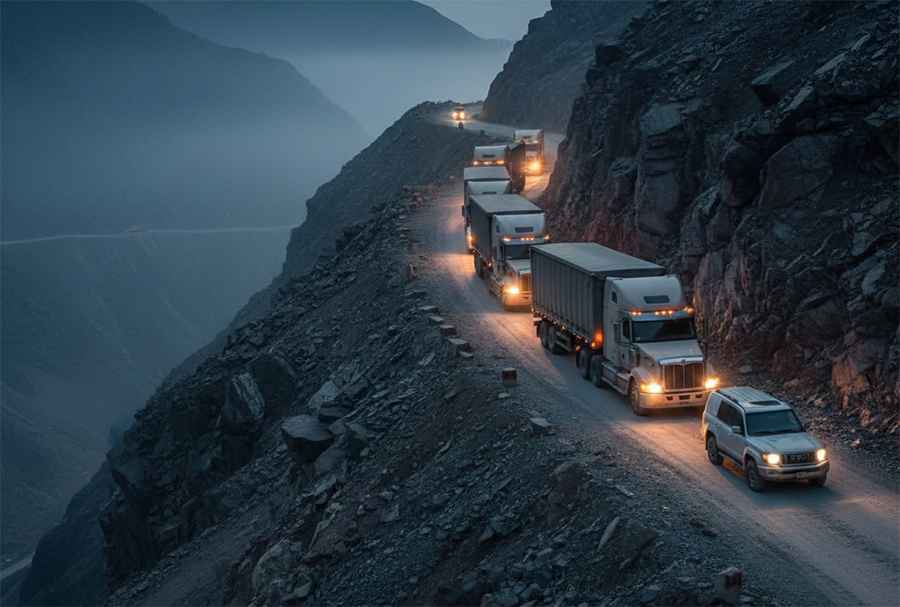
On dangerous roads like the **Sitinjau Lauik** or Andean passes, trucks often require the entire width of the road to navigate hairpins.
- The "Sandwich" Risk: Never position your vehicle between two moving trucks. In the event of a sudden braking maneuver, the smaller vehicle is at risk of an "underride" collision.
- Predictive Lane Management: If you see a truck ahead preparing for a steep climb or a sharp turn, give them extra space. Their momentum is their primary tool, and forcing them to brake mid-climb can cause them to lose traction or stall, creating a hazard for everyone behind.
4. Nighttime Communication and Light Etiquette
Visibility is the cornerstone of night safety. When following or passing a truck at night, **dim your high beams**. The massive mirrors on a truck can reflect high-intensity light directly into the driver’s eyes, causing temporary flash blindness. Use your turn signals significantly earlier than usual; a truck driver needs more time to adjust their speed or lane position to accommodate your movement. Clear, predictable communication reduces the cognitive load on the professional driver and ensures a safer flow of traffic.
Conclusion: The Professional Mindset
Sharing the road with heavy vehicles is a test of your situational awareness and respect for mechanical limits. By treating truck drivers as professional partners and staying out of their No-Zones, you significantly reduce the risk of high-impact accidents. On the world's most dangerous roads, the safety of the smallest vehicle often depends on the foresight of its driver to give the largest vehicle the room it needs to operate.