Urban Logistics: A Technical Guide to Choosing High-Performance Electric Scooters
Electric scooters have transitioned from leisure gadgets to critical tools for urban micro-mobility. For adults navigating congested road networks, these vehicles offer an autonomous and efficient alternative for short-to-medium transits. However, selecting the right hardware requires an analysis of technical specs such as wattage, battery autonomy, and structural integrity. This guide breaks down the logistical factors and safety measures necessary for operating a professional-grade electric scooter in an urban environment.
| Scooter Operational Specs | |
|---|---|
| Power Output | 250W to 1,000W (Depending on payload) |
| Battery Autonomy | 15 km to 45 km per charge cycle |
| Wheel Logistics | 180 mm to 230 mm for optimal stability |
| Environmental Impact | Zero-emission operation (Reduces up to 1,600kg CO2/year) |
1. Power-to-Weight Ratio and Motor Efficiency
The operational efficiency of an electric scooter depends heavily on its motor's wattage relative to the user's weight. For standard urban logistics, a motor between 250W and 400W is sufficient for users up to 80 kg. However, for heavy-duty adult use or terrain with steep gradients, a high-output 500W to 1,000W motor is required to maintain constant speeds and prevent mechanical strain. Selecting the correct power profile ensures the vehicle can keep up with the flow of urban traffic without compromising the battery life.
2. Managing Battery Autonomy and Range Logistics
Autonomy is the primary constraint in micro-mobility. A professional-grade scooter should offer a range between 25 km and 45 km to cover most daily commuting cycles. Battery capacity is measured in ampere-hours; higher amperage directly correlates to increased range but also adds to the vehicle's total weight (often around 26 kg for long-range models). Logistical planning must account for charging times and the availability of power points at both ends of the transit to ensure the vehicle remains operational.
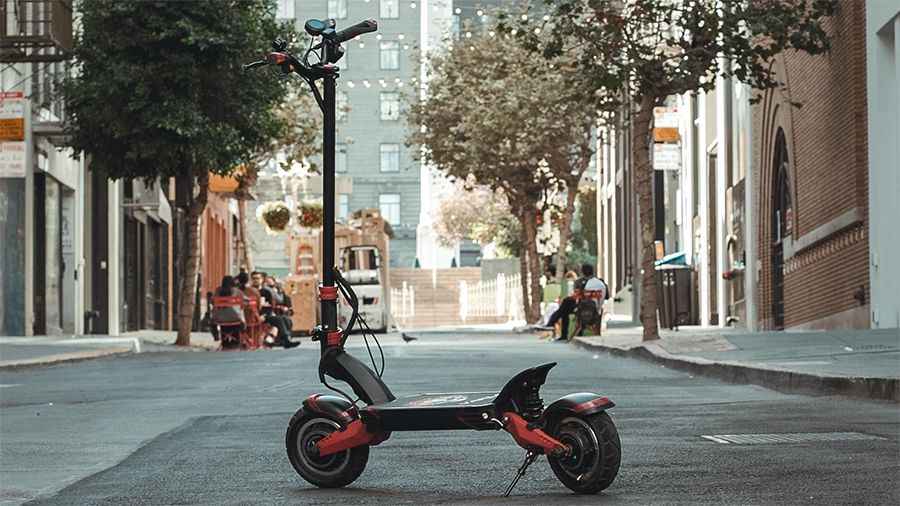
[Image showing a high-performance electric scooter with large wheels and dual suspension, parked next to a modern urban bike lane]
3. Structural Integrity and Road Surface Adaptation
Navigating urban roads involves dealing with uneven pavement, joints, and debris. Structural features like rear shock absorbers and wide platforms are non-negotiable for safety. Larger wheels (200 mm+) provide significantly better stability and vibration dampening than smaller ones. For those with mobility issues or back problems, a robust suspension system is the key logistical factor that allows for long-duration use without physical fatigue. Stability is safety, especially when operating at the higher speed brackets of 30-45 km/h.
4. Safety Protocols and Braking Systems
Operating a motorized vehicle on public infrastructure requires strict safety protocols. High-performance scooters must be equipped with efficient braking systems—ideally a combination of electronic and disc brakes—to handle sudden stops in traffic. Visibility is another critical logistical component; integrated LED lighting and reflective surfaces are essential for low-light navigation. Always prioritize models that allow for a stable, wide stance to maintain balance during complex maneuvers in high-density urban sectors.
Conclusion: The Future of Efficient Urban Transit
Electric scooters represent a sustainable and fast solution to the problems of urban congestion and parking. By selecting a vehicle based on technical specs like power, autonomy, and wheel size, you turn a simple commute into a professional logistical operation. Respect the road rules, maintain your battery health, and focus on the road. A well-chosen scooter not only reduces your carbon footprint but also enhances your mobility and independence in the modern city.