Wild Japan: Where the Roads Lead Into the Forest
For most travellers, Japan means neon, bullet trains and crowded crossings. Yet a few hours beyond the big cities, the roads narrow, the cedar forests close in and the country changes its rhythm completely.
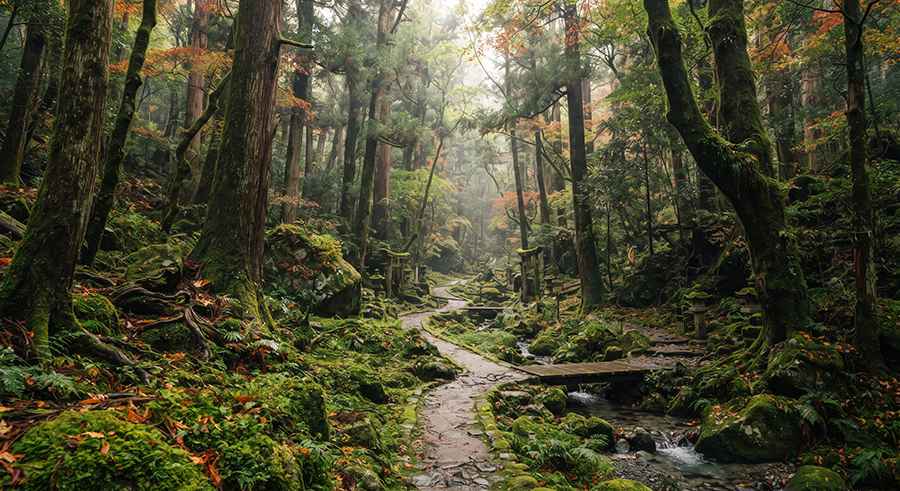
In Japan, a forest is more than a place for a walk. It can be a conscious form of retreat.
"Shinrin yoku" (usually translated as "forest bathing") emerged in the 1980s as a public health initiative. Today the term stands for far more than a wellness trend. For many Japanese people, it expresses an attitude: slowing down, changing your own rhythm, not consuming nature but perceiving it.
Those who walk through these forests often do so without any athletic ambition. What matters is not the distance covered, but what you notice: birdsong, damp air, the cracking of branches, light filtering through cedar trees.
Studies now also look at the effects of time spent in forests from a scientific perspective. Under discussion are, among other things, lower stress levels, better sleep and positive effects on the immune system. So called phytoncides, natural compounds released by trees, appear to play a role.
The forests behind the neon lights
Nearly 70 percent of Japan is forested. Even around Tokyo or Osaka, mountain landscapes, hot springs and centuries old cedar forests begin surprisingly close to the city limits. Nature there is not a counterpoint to civilisation, but part of everyday life.
This is particularly evident on the Kii Peninsula south of Osaka. Historic pilgrimage routes wind through dense cedar forests that have been tended for centuries. In the Yoshino region, so called "yamamori" still work today: traditional forest wardens whose families have cared for entire forest landscapes for generations.
"Japan is often associated with density and efficiency, but large parts of the country feel remarkably quiet and untouched. That is why we always encourage travellers to look beyond the familiar city images. The forested regions show a Japan that is slower, older and deeply connected to the landscape," says Karolina Simon, Head of Japanspecialist.
Old routes, slow travel
Many of these regions are best reached slowly: on local trains, by bus over mountain passes, or on foot along old trade and pilgrimage routes. The Kumano Kodo leads through the forests of the Kii Peninsula. The historic Nakasendo once connected Kyoto and Edo, today's Tokyo, and still passes small post towns in the mountains. In the Japanese Alps, winding roads climb towards misty valleys, mountain villages and hot springs.
"The nature experience in Japan is never one single thing. In Yakushima, you have ancient cedar forests with an almost mythical atmosphere. In the Kii Peninsula, the cypress and cedar forests are closely tied to pilgrimage routes and spiritual traditions. In the Japanese Alps, the landscape feels completely different again: mist, mountain villages, hot springs and a slower rhythm. That regional variety is exactly what makes these journeys so rich," says Jeremy Batt, Product Manager at Japanspecialist.
Those who want to experience Japan beyond the classic "Golden Route" quickly discover regions that are barely known in Europe or North America.
In the north lies Hokkaido, which Japanspecialist likes to call "Wild Japan". The island is shaped by volcanic landscapes, national parks, dense forests and long winters. Unlike many classic group destinations, Hokkaido mainly attracts independent travellers, nature lovers and people who want to experience Japan at a more deliberate pace.
Where Japan slows down
Japan has a different relationship between people and nature. Forests are often not seen as a spectacular backdrop, but as spaces for attentiveness.
This attitude is also reflected in many traditional inns. Ryokans open deliberately towards the landscape, hot springs sit in the middle of forests, and rooms work with natural materials, light and silence.
How to experience Japan more intensively
Getting to places that feel authentic can be a challenge for international visitors. Japan is still seen by many as fascinating but complex: language barriers, the rail system, regional particularities or remote accommodation can feel daunting at first.
This is exactly why many travellers rely on specialist advice and individually curated itineraries.
"I normally travel independently," one traveller from Germany writes about their experience with Japanspecialist, "but with Japan I had reservations because of the language, the rail system and the organisation." Individual route suggestions and personal support were particularly helpful.
Other travellers praise the combination of local expertise and organisational security: precise itineraries, suitable ryokans, English speaking guides and recommendations away from the usual tourist trail.
"A lot of our travellers have already seen the big images of Japan online. What they are looking for now is something quieter and more grounded: a ryokan that opens onto the forest, a walk on an old pilgrimage path, a region where they can slow down. They want to feel that they have understood something, not just photographed it," says Peter Schmidt, Sales Manager DACH at Japanspecialist.
Those who leave Tokyo in the morning and stand alone in a quiet cedar forest a few hours later quickly understand why the country holds such a special fascination.
About Japanspecialist
Japanspecialist, formerly known as JTB Germany, is a global travel agency and part of JTB Corporation. Under one global brand, we bring together decades of local expertise and combine in-depth cultural knowledge with international reach.