How to Keep Your Motorcycle Safe on a Long Road Trip
You crest the last pass of the day with cold hands and an empty tank, drop into a small town near the border, and find the only hotel with a free room. There is no garage. The bike will spend the night on the street, loaded with luggage, under a single flickering lamp.
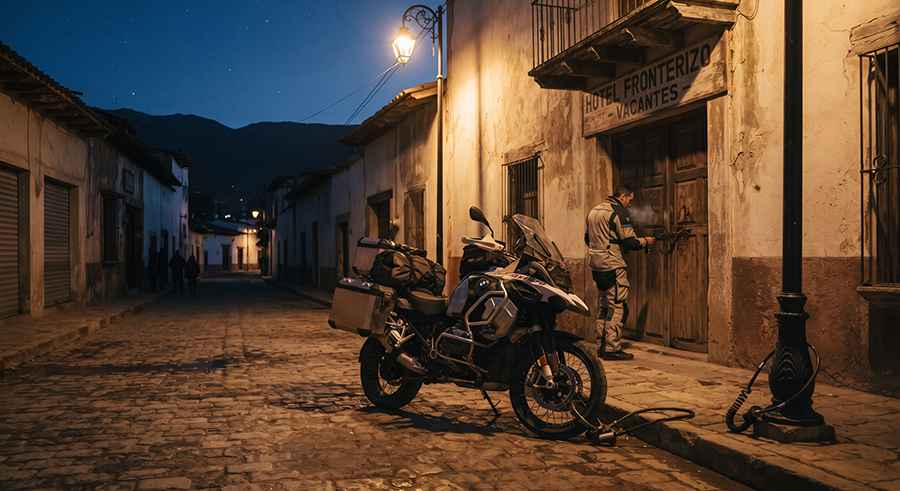
Most long-distance riders know that moment. The roads get the attention when you plan a trip, but the stops are where a motorcycle is most exposed. What follows is a practical guide to keeping your bike where you left it: at overnight stops, at remote viewpoints high in the mountains, and in the busy, transient border towns that sit between one country and the next.
Why a Stolen Motorcycle Rarely Comes Back
A motorcycle is easier to take than a car. Two people can lift one into a van in moments, and there is no cabin to break into first. Once it is gone, the odds of seeing it again are poor.
The Netherlands publishes unusually detailed figures on this. According to the annual theft statistics (in Dutch) of LIV, the national vehicle-crime center, whose figures come from police theft reports, 1,877 motorcycles were stolen there in 2023, and only 22% were recovered. For passenger cars the recovery rate was 47%. That gap has barely moved in five years.
Chart 1: Share of stolen vehicles recovered in the Netherlands, 2019 to 2023
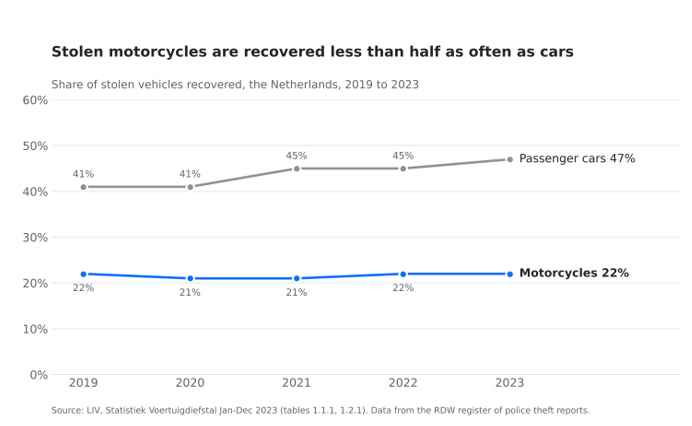
Source: LIV, Statistiek Voertuigdiefstal Jan-Dec 2023 (tables 1.1.1 and 1.2.1).
Timing matters too. Of the 7,910 stolen vehicles of all types recovered in the Netherlands in 2023, about one in three turned up within a day of the theft.
Away From Home, the Odds Get Worse
The same LIV report tracks Dutch vehicles stolen in other countries. In 2023, 33 Dutch motorcycles were reported stolen abroad, and exactly one was recovered. Dutch cars stolen abroad were found 17% of the time. Travelers are a target in the other direction as well: 101 foreign-registered motorcycles were stolen inside the Netherlands that year.
The numbers are small, but the pattern makes sense. Abroad, you do not know which streets are safe, you may not speak the language at the police station, and a thief has a border nearby to put between you and your bike.
Chart 2: Recovery rate of Dutch vehicles stolen at home vs. abroad, 2023
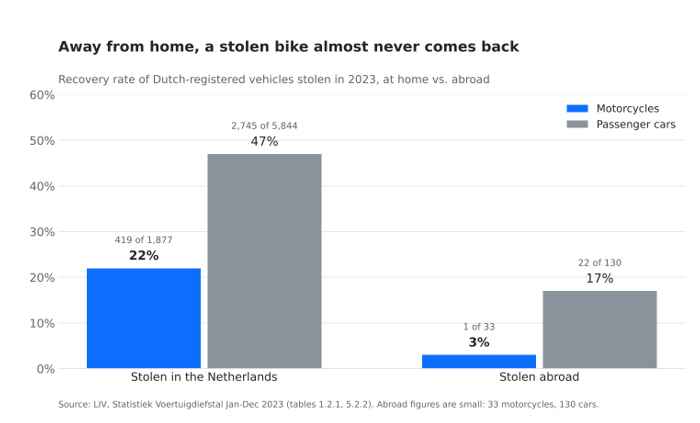
Source: LIV, Statistiek Voertuigdiefstal Jan-Dec 2023 (tables 1.2.1 and 5.2.2). Abroad: 33 motorcycles, 130 cars.
Before You Leave
Security on the road starts in your garage at home.
- Photograph the bike from every side, plus any scratches, modifications and aftermarket parts. Write down the frame (VIN) and engine numbers and keep them in your phone and in your email.
- Carry the right papers, and carry them on you. For UK riders, the government's driving abroad checklist says to take your log book (V5C) and your insurance certificate when you take your own vehicle. Keep the originals in your jacket, not under the seat, and a scan in the cloud.
- Check your insurance for every country on the route, including theft cover, before you ride.
- Pack your locks where you can reach them. A disc lock buried at the bottom of a pannier will not get used at a ten-minute coffee stop.
- Leave the spare key at home or with someone you trust, never in the luggage.
Overnight Stops
This is where most of the risk sits. A bike parked for eight or ten hours in the dark gives a thief all the time they need.
Book ahead where you can and ask a simple question: is there secure parking for a motorcycle? Many small hotels on popular riding routes have a courtyard, a garage or a spot behind a locked gate. If they say no, ask where the owner parks.
When the bike has to stay outside, make it the least attractive one on the street:
- Park in a lit spot within sight of reception or a camera, nose against a wall so it can't simply be rolled away.
- Use the steering lock and a disc lock, with a bright reminder cable running to the handlebar so you don't ride off with it fitted.
- Run a chain through the frame, not the wheel, and around something that can't be moved. Keep the chain off the ground so it can't be braced and cut.
- Cover the bike. A plain cover hides the model, the luggage and the locks, and slows anyone who wants a closer look.
- Riding in a group? Chain the bikes to each other. Several bikes locked together are far harder to load.
Then add a layer a thief can't see. Physical locks buy time, but they don't tell you when that time is running out. A hidden motorcycle GPS tracker tucked under the seat or inside the tail section will alert your phone if the bike is moved, so you are calling the police in minutes instead of discovering an empty parking spot at breakfast. Given how many vehicles are found within the first day, those hours count.
Remote Mountain Passes and Viewpoints
High passes create a different problem. You stop at a summit for photos, or leave the bike at a trailhead for a short hike, and suddenly you are a long way from it with no one else around.
Take the key every time, even for two minutes. Lock the steering, and carry your tank bag or anything valuable with you. If you walk away from the road, choose a spot where the bike stays in view of other visitors rather than a hidden pull-off.
Remember that phone signal is patchy or absent on many remote passes. Any alert system needs coverage to reach you, so on long stretches without signal your locks are doing the work alone. Plan longer stops for places with signal, people or both.
Border Towns and Busy Crossings
Border towns move a lot of vehicles and strangers, which is what makes them useful to thieves. Bikes queue in the open, riders step away to deal with paperwork, and nobody looks twice at a motorcycle being pushed through traffic.
- Never leave the key in the ignition while you go to a counter, however short the queue looks.
- Keep documents in an inside pocket so you never have to leave the bike to fetch them from a pannier.
- Avoid stopping overnight right on the border if you can ride another 30 or 40 miles to a quieter town.
- Keep your itinerary off social media until you have left a place.
If the Bike Disappears Anyway
Act fast, because the first hours matter most.
- Report the theft to the local police immediately and ask for a written report or reference number. Your insurer will need it.
- Give the police the frame and engine numbers and the photos you took before the trip.
- If you have a tracker, share the live location with the police and let them handle the recovery. Do not try to retrieve the bike yourself.
- Call your insurer and your embassy or consulate if you need help with documents or travel home.
- Watch local online marketplaces for your bike and its parts.
Your Last Stop Is Your Weakest Link
The great roads are why you ride, but a trip is only as safe as the place you park at night. Plan your stops as carefully as your route, lock the bike as if you will be gone for days, and give yourself a way to know when something is wrong. Then you can get back to worrying about the next set of hairpins.