Dominica Roads & Citizenship by Investment: The Adventure Traveler's Complete Guide
Picture this: a rain-soaked switchback carved into a cliff face, no guardrail, a sheer drop into jungle below, and a minibus coming the other way. Welcome to driving in Dominica.
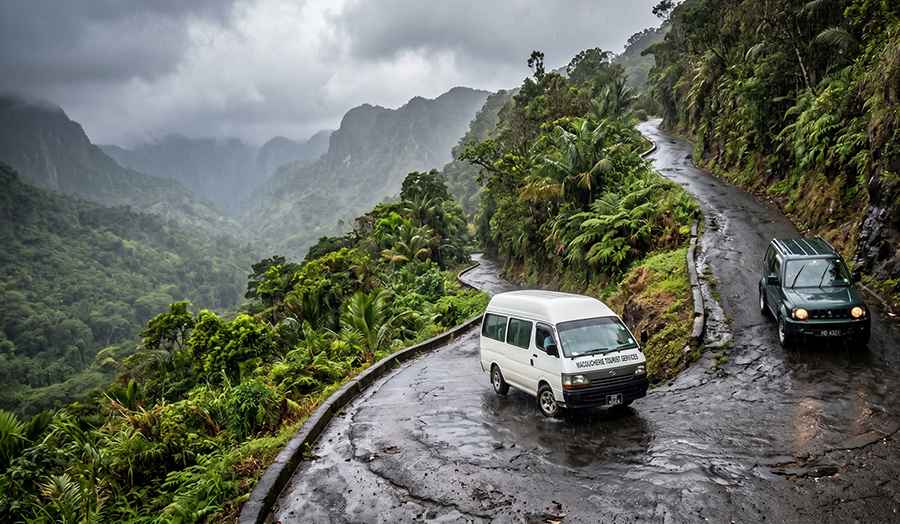
Most Caribbean islands offer smooth coastal highways and tourist-friendly roundabouts. Dominica is not most Caribbean islands. The roads here are genuinely challenging — narrow, steep, slick, and unpredictable in ways that separate casual renters from serious drivers.
But here's what makes Dominica genuinely unique: the same country offering some of the most demanding driving terrain in the Western Hemisphere also runs one of the world's longest-running and most established citizenship by investment programs.
So the question worth asking is — what if the wildest road you've ever driven also led to a second passport?
Why Dominica's Roads Intimidate Even Experienced Drivers
Dominica's roads are paved. That's often the only reassurance available before the terrain takes over.
The island's core ring road traces the coastline, with interior spurs cutting through dense rainforest and volcanic peaks. Speed limits officially cap at 64 km/h on rural roads and 32 km/h in towns — but real-world speeds on interior stretches are often far lower. The geometry simply doesn't allow anything faster.
Common hazards that catch foreign drivers off guard include:
- Deep roadside drainage ditches that disappear at night without warning
- Livestock, iguanas, and stray dogs appearing mid-corner
- Minibuses stopping abruptly in the travel lane to collect passengers
- Blind hairpin bends with no sightlines and limited room to maneuver
The coastal Nicholas Liverpool Highway adds another layer of risk. During storm season, wave overtopping and rockfall make sections temporarily impassable. After an April 2026 trough system, the government issued warnings along the east–northeast corridor between Wesley and Rosalie, advising against all non-essential travel due to active landslide and rockfall risk.
Adventure drivers tend to describe the interior passes as "rally stage" terrain. That's not hyperbole — it's an accurate operational brief.
What You Actually Need to Drive Here
Foreign visitors cannot simply use their home license. A temporary visitor's driving permit is required, obtainable at rental agencies or traffic departments on arrival.
Beyond the permit: seatbelts are mandatory, mobile phone use without hands-free is banned, and the blood alcohol limit is 0.05% BAC. Driving is on the left, with right-hand drive vehicles standard. For the interior, a compact 4×4 is not optional — it's the sensible minimum. Use the horn liberally on blind corners. Emergency services follow the UK model: dial 999.
Nature Isle 101: The Geography Behind the Chaos
Dominica's road difficulty isn't bad planning. It's geology.
The island is steep, volcanic, and densely forested, with central peaks forcing every road into tight contours and aggressive gradients. Numerous rivers cut across the terrain. Rainfall is heavy year-round and intensifies dramatically during the June–November Atlantic hurricane season, when troughs and cyclones can dump enough precipitation to trigger simultaneous landslides across multiple road corridors.
Tourism has recovered strongly from the pandemic era, with 2025 visitor arrivals estimated near 480,000–500,000 across cruise, stayover, and yacht segments. A new international airport, expected to open around 2026, will bring long-haul access and more rental vehicles onto roads that are already working hard.
The government, with World Bank support, has established a National Road Asset Management System specifically designed to track landslide damage and prioritize post-storm repairs. The roads stay wild — but they're being made incrementally more resilient with each infrastructure cycle.
From Hairpins to Passports: Inside Dominica's CBI Program
Dominica's Citizenship by Investment program has been running since 1993 — longer than most other economic citizenship schemes anywhere in the world. That longevity matters. It signals institutional stability and a government that has navigated multiple reform cycles without abandoning the program.
The program is administered by the Citizenship by Investment Unit (CBIU) under the Ministry of Finance, governed by the 1978 Citizenship Act and subsequent CBI Regulations. In 2024, a comprehensive overhaul updated the legal framework with revised thresholds and clearer definitions. On October 14, 2025, further reforms addressed residency verification, due diligence depth, transparency obligations, and enforcement — partly in response to international pressure from the United States and regional partner governments.
The result is a program that has tightened meaningfully but remains active, credible, and popular among mobility-focused investors globally.
Your Two Investment Options: Fund vs. Eco-Resort
There are two primary pathways to Dominica citizenship:
Non-refundable contribution to the Economic Diversification Fund (EDF): The minimum for a single applicant currently sits at approximately $200,000 USD. A family of up to four runs around $250,000 USD, with additional surcharges of $25,000 per dependent under 18 and $40,000 for dependents aged 18 and over. This money goes directly to the government and is not returned.
Government-approved real estate: The minimum purchase threshold is also $200,000 USD, with a holding period of at least three years — or five years if selling to another CBI investor. Approved projects lean heavily into Dominica's eco-adventure identity: think Jungle Bay Eco Villas, Sanctuary Rainforest Eco Resort & Spa, and Tranquility Beach Resort. These aren't generic hotel units — they're positioned for the wellness, diving, and rainforest tourism market that's growing fast.
All-in costs including government fees, due diligence fees per adult, and professional or agent fees typically bring a single EDF application to around $210,000–215,000 USD. Families of four often see totals in the $260,000–280,000 range. Verify current figures directly with an authorized advisor, as these can shift.
For those exploring the Dominica CBI program in depth, Global Residence Index offers current schedules, pre-screening, and end-to-end application support — their team has navigated this program through multiple reform cycles and maintains direct relationships with the CBIU.
What a Dominican Passport Actually Buys You
The practical value of Dominican citizenship for a globally mobile person is significant.
Visa-free or visa-on-arrival access covers roughly 136–145 destinations, including the Schengen Area, United Kingdom, much of Latin America, and several key Asian hubs. Recent passport indices place Dominica around 31st globally. That's not the top of the table, but it's comfortably within the tier that makes international movement genuinely frictionless for most routes.
For non-resident citizens, Dominica imposes no tax on worldwide income, capital gains, or inheritance. That's a meaningful planning advantage for entrepreneurs, digital nomads, and asset-holding investors who travel more than they stay put.
Under the 2025 regional agreement among Caribbean CBI states, new citizens will need to accumulate at least 30 days of physical presence in Dominica within the first five years of citizenship. A June 2026 announcement further confirmed that new CBI citizens must collect and renew passports in person on the island. For the right kind of person, this isn't a burden — it's an invitation to actually drive those jungle switchbacks with a purpose.
How Dominica Stacks Up Against Other Caribbean CBI Islands
Five main Caribbean CBI programs compete for investor attention. Here's how the 2026 landscape looks for minimum non-refundable contributions:
- Dominica: $200,000 USD
- Antigua & Barbuda: $230,000 USD
- Grenada: $235,000 USD
- St. Lucia: $240,000 USD
- St. Kitts & Nevis: $250,000 USD
Real estate thresholds across the region range from $200,000 in Dominica up to $325,000–600,000 in St. Kitts. Processing times have converged toward 8–10 months across most programs, so cost, due diligence comfort, and lifestyle fit have become the real differentiators.
St. Kitts & Nevis often edges Dominica on passport strength. Grenada uniquely offers US E-2 visa eligibility and visa-free access to China. But for single applicants prioritizing cost-efficiency and a long-established program, Dominica consistently ranks among the top choices. For families of four, Antigua & Barbuda frequently works out cheaper — worth modeling before committing.
Dominica's eco-adventure identity also gives it something competitors struggle to match: a reason to actually want to be there. That matters more now that physical presence is required.
The Process: From First Inquiry to First Mountain Pass
The application process follows a clear sequence. Eligibility requires being at least 18 years old, holding a clean criminal record, demonstrating a legal source of funds, and meeting health requirements. Documentation includes passports, police certificates from all countries of residence, bank references, financial records, medical reports, and relevant family documents for dependents.
Dominica introduced mandatory online interviews for all applicants aged 16 and over as part of its 2024 and 2025 reforms. Some nationalities face additional screening requirements — Iranian applicants, for example, encountered new restrictions effective March 2026 — reflecting a global shift toward risk-based due diligence filtering.
Processing typically runs 6–9 months from complete file submission, though straightforward cases handled by experienced advisors sometimes move faster. The CBIU does not consistently publish approval rate data, but industry reporting consistently places Dominica among the most active programs in the Caribbean by volume.
For a smooth application — especially given recent reform complexity — working with an established firm like Dominica CBI program with Global Residence Index gives applicants pre-screening support, document preparation, and direct government liaison that significantly reduces the risk of delays or errors.
Who This Is Really For
The honest answer: Dominica's CBI program is not for everyone, and neither are its roads.
The people who find real value here tend to share a few characteristics. They travel frequently and feel the friction of limited passport access. They hold assets across multiple jurisdictions and want structural flexibility on taxation. They run location-independent businesses or consult globally. And critically — they actually want to visit Dominica, not just hold a passport issued there.
That last point now carries regulatory weight. The 30-day presence requirement within five years, combined with the in-person passport collection requirement, means the completely-remote investor profile no longer fits this program cleanly.
For adventure-driven high-net-worth individuals, digital nomads, and globally mobile entrepreneurs, the alignment is unusually strong. Dominica offers a second passport with real mobility value, a favorable tax environment, eco-resort investment options with genuine tourism upside, and terrain that rewards drivers who actually know what they're doing.
The roads in Dominica are as wild as advertised. The program is more robust than it's ever been. For the right person, those two facts belong in the same sentence.