The roads that dare you to drive them
There is a particular kind of traveler who looks at a map and gravitates — almost magnetically — toward the thin, winding lines that end in question marks. Not the broad highways stitched between airports, but the crumbling ledge roads carved into Andean cliffs, the fog-swallowed passes of the Himalayas, the salt flats of Bolivia where the horizon disappears entirely. These are roads that don't ask where you're going. They ask whether you're serious about going at all.
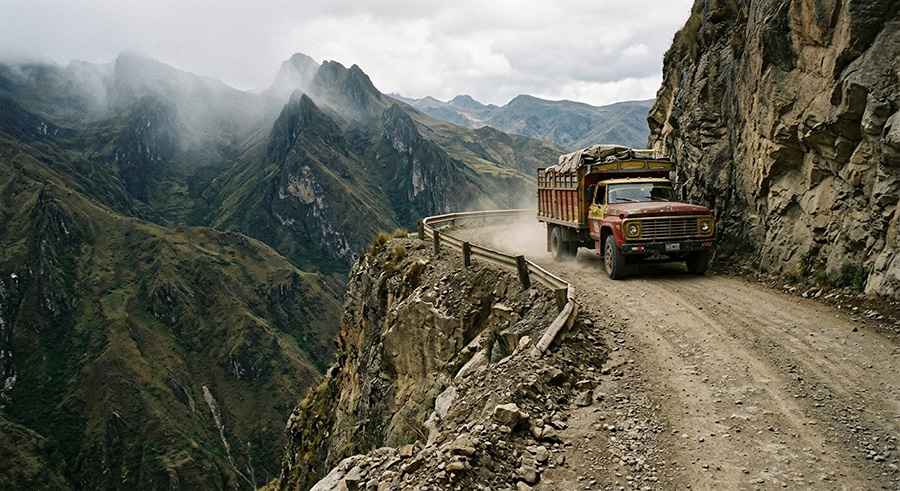
Dangerous roads are not a niche curiosity. They are a mirror — a reflection of what travel truly is when stripped of its comforts. The moment your wheels leave the paved certainty of a well-worn tourist route, something shifts. Your senses sharpen. The landscape stops being scenery and starts being a conversation you must respond to in real time.
"The world's most thrilling routes reward not the reckless, but the prepared — those who arrive with respect and leave with stories."
WHERE THE WORLD GETS STEEP
Bolivia's Yungas Road — nicknamed the Death Road — descends nearly 3,600 meters from the Andean plateau into the Amazon basin. Its single-lane dirt track, barely wide enough for one vehicle, clings to cliff faces above thousand-foot drops. Waterfalls pour directly across the road in the rainy season. Yet each year, tens of thousands of cyclists and adventurers travel it intentionally, drawn by the sheer audacity of its existence.
The Karakoram Highway, crossing the highest paved international border in the world at 4,693m, connects Islamabad to Kashgar across some of the most geologically active terrain on earth. Landslides, altitude sickness, and sudden weather shifts make this a road that demands preparation — and rewards it with scenery that no photograph has ever fully captured.
In Norway, the Trollstigen — Troll's Ladder — twists up eleven hairpin bends in rapid succession, scaling a near-vertical mountain face above a roaring waterfall. In Ethiopia, the Semien Mountains route passes through villages accessible by no other means, with sheer drops inches from your tyres and baboons watching from the verge. In the Philippines, the Halsema Highway between Baguio and Bontoc is a clay mountain track that turns to treacherous mud the moment clouds arrive — which they do constantly.
What these roads share is not merely danger. It is consequence. Every decision matters. Every kilometre is earned.
GETTING THERE: THE JOURNEY BEFORE THE JOURNEY
Reaching the world's most remote and dramatic roads often requires creative logistics. Many of these routes are not serviced by direct international flights. You may need to chain together two or three connections — from a regional hub to a secondary airport, then overland to a trailhead or border post. Seasoned adventure travelers swear by finding cheap flights on Kiwi, whose flexible search tools allow you to mix carriers and routes that traditional booking sites miss entirely — critical when your destination is somewhere like Lukla, Nepal, or Iquitos, Peru, accessible only by air.
Budget matters enormously on these trips. The more you save on transport, the more you can invest in local guides, proper equipment, and safety contingencies. An experienced local guide on Bolivia's Death Road or the mountain passes of Georgia's Military Highway is not a luxury — it is insurance written in human form.
THE ETHICS OF THRILL-SEEKING
Adventure travel carries responsibility. Many of these roads pass through communities that have little say over the stream of outsiders who arrive chasing adrenaline. Spending locally — hiring village guesthouses, eating at roadside stalls, engaging licensed regional guides — is not just economically respectful. It is the difference between tourism that extracts and tourism that sustains.
Dangerous roads also demand honest self-assessment. Are you physically prepared for altitude? Do you have the mechanical knowledge to handle a breakdown three hours from the nearest town? Has your vehicle been properly serviced? The road does not care about your ambitions. It only responds to your readiness.
WHY WE GO
Ask anyone who has driven a truly difficult road and they will struggle to explain it. The fear, the focus, the strange serenity that arrives when there is nothing to do but navigate — these are not things that translate well into language. They are felt in the body. In the specific texture of white-knuckling a steering wheel above a cloud. In the silence after you've made it through.
We go because the world is large and ordinary life is small. We go because some things can only be understood by doing them. And we go — carefully, respectfully, with eyes wide open — because the most dangerous roads on earth are also, without exception, the most beautiful.