Choosing Safe Lifting Solutions for Heavy Expedition Rigs
When your vehicle is stuck in a remote canyon or requires a tire change on a 30-degree lateral slope, your lifting equipment becomes your most critical survival tool. Developing an efficient lifting plan in the wilderness is challenging, as terrain stability and vehicle weight are constant variables. Finding professional lifting solutions requires moving beyond generic hardware and understanding the engineering behind safe off-road recovery operations.
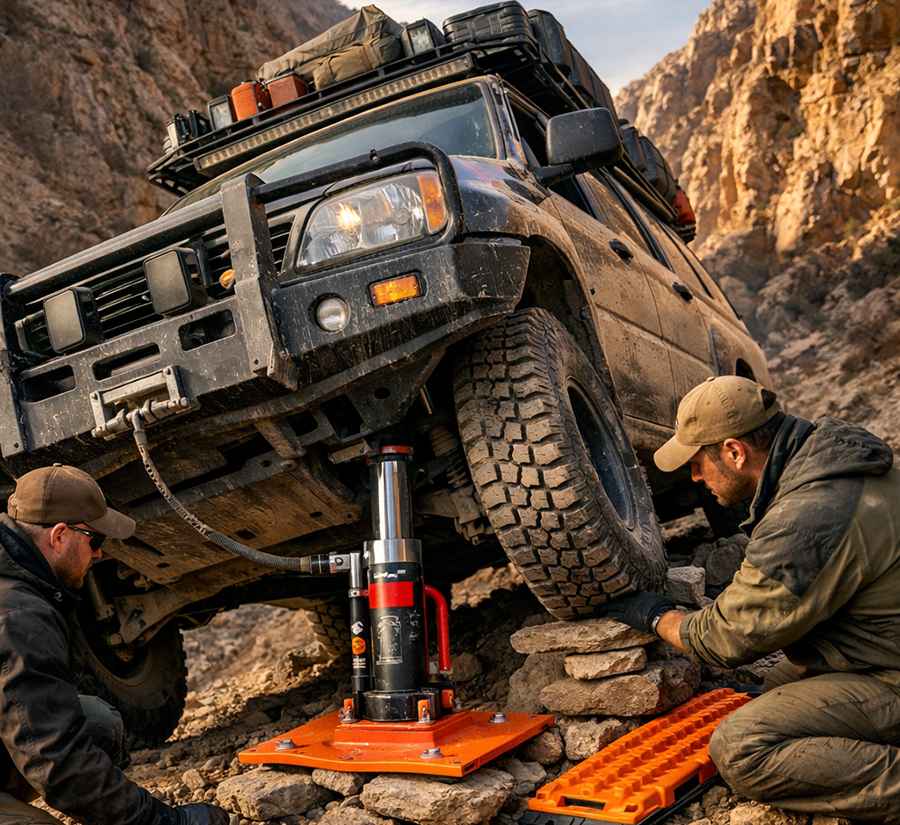
| Expedition Lifting Gear Matrix | |
|---|---|
| Equipment Type | High-Lift Mechanical Jacks, Hydraulic Bottle Jacks, and Exhaust Air Bags. |
| Safety Factor | Minimum 2:1 Rated Capacity vs. Loaded Vehicle Weight. |
| Base Stability | Wide-foot bases or sand plates for soft ground operations. |
Identify Your Recovery Goals
The first step in selecting a lifting solution is to identify your specific recovery goals. Are you looking for a system to perform field repairs under the chassis, or do you need a high-clearance lift to extract a buried axle from deep mud? Instead of making a rushed decision based on price, prioritize systems with features relevant to off-road stability. A clear goal ensures you pick a system that fits the unique weight distribution of a fully loaded expedition rig.
Research Professional Grade Solutions
Researching different lifting solutions online is the only way to ensure quality and safety. For heavy-duty applications, generic automotive jacks are often insufficient. Professionals look for top-of-the-line equipment from specialized recovery brands known for their rigorous quality standards. Before purchasing, look up technical reviews and stress-test data. Reliability is non-negotiable when you are hundreds of kilometers away from the nearest service station.
The True Cost of Cheap Equipment
While finding a good deal can help stretch your budget, never forget that quality matters more than the price tag. Cheap lifting solutions can end up costing much more in the long run if a component fails during a critical recovery, potentially causing catastrophic damage to the vehicle or injury to the operator. Balance cost with value, but prioritize forged steel components and certified load ratings over promotional discounts.
Evaluate Field Performance Through Expert Reviews
One of the most effective ways to find a reliable lifting solution is to study reviews from the overlanding community. Through this process, you can understand how a jack performs in real-world conditions—such as extreme cold, sand ingress, or mud. Pay attention to how the equipment handles lateral loads, which is a common point of failure in off-road lifting. This research is a vital part of your strategy to find a product that best suits your needs.
Testing and Trial in Controlled Environments
Before heading out on a major expedition, it is essential to test your lifting options in a controlled environment. Experiment with your hydraulic or mechanical jacks on different surfaces to understand their stability limits. By testing them on a small scale first, you can identify potential issues—such as the need for larger base plates or specific jacking points on your chassis—before investing in a high-risk situation in the wilderness.
Conclusion: Engineering Your Safety
Finding good lifting solutions is a matter of research and technical analysis. Take your time to explore all of the options available to the expedition community. Compare load ratings, study forensic failure reviews, and ask for recommendations from experienced overlanders. With a bit of trial and error in your workshop, you will find the best lifting solutions to keep your rig moving, no matter how difficult the terrain becomes.