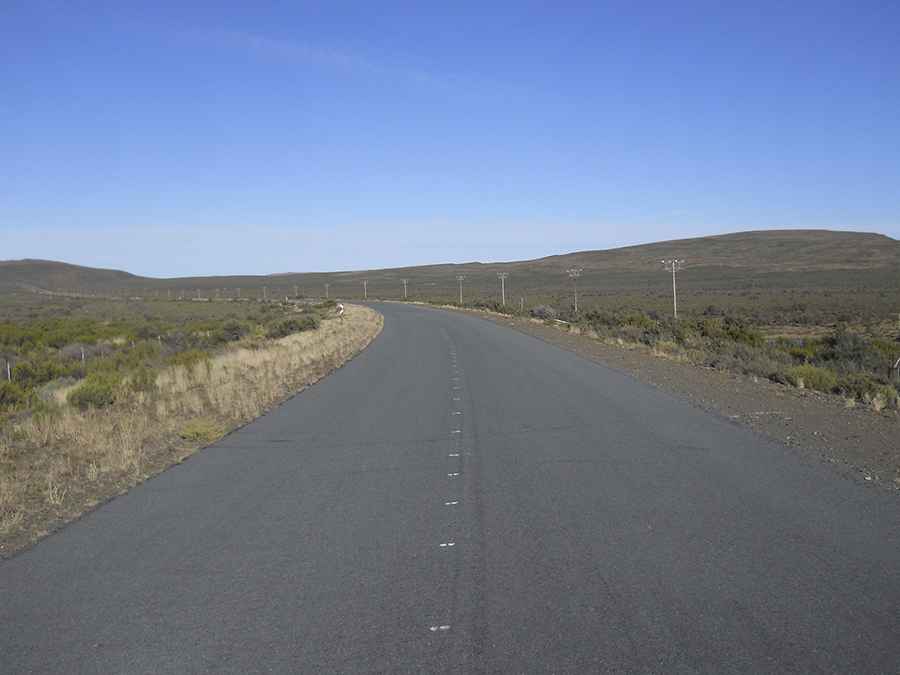
Driving the R381 road through Blounek in the Great Karoo
Blounek is a high mountain pass reaching an elevation of 1,643m (5,390ft) above sea level, straddling the Western Cape and Northern Cape provinces of South Africa. Located within the Nuweveld Mountain Range, the pass is a critical logistical link on the R381, connecting the arid Great Karoo region with the northern interior.
| Road facts: Blounek (R381) | |
|---|---|
| Location | Western/Northern Cape, South Africa |
| Elevation | 1,643 m (5,390 ft) |
| Road Number | R381 (Mixed Surface) |
| Length | 110 km (68.3 miles) |
| Adjacent Passes | Molteno Pass & Roseberg Pass |
How challenging is the R381 road through Blounek?
The 110 km (68.3 miles) drive through Blounek is a demanding logistical transit due to its mixed surface. Running from Beaufort West to Loxton, the road transitions between asphalt and corrugated gravel sections. Technically, the most hazardous aspect is the unpredictable traction when moving between these surfaces, especially along the eastern boundary of the Karoo National Park. The 110 km stretch requires total vehicle self-sufficiency, as the arid environment of the Great Karoo offers zero mechanical support or services for long durations.
What are the driving conditions on Blounek?
The road through Blounek was originally completed in 1881, and much of the modern R381 alignment follows these historic, narrow gradients. Technically, the pass is subject to severe dust plumes that can reduce visibility to near zero on the unpaved sectors. Logistically, drivers must manage tire pressures carefully to handle the sharp Karoo shale, which is notorious for causing sidewall punctures. The route is positioned between the Molteno Pass and Roseberg Pass, forming a high-altitude corridor that puts sustained stress on the suspension systems of heavy-duty 4x4s and freight trucks.
Is the road to Blounek open all year?
While the Blounek pass is generally open year-round, its location in the Nuweveld Mountain Range makes it susceptible to extreme thermal shifts. In summer, the 110 km transit is a test of the vehicle's cooling system under intense heat, while winter can bring occasional snow and black ice to the 1,643m summit. Logistically, the main risk is flash flooding after rare but heavy Karoo storms, which can wash out the gravel sections of the R381. Always ensure extra fuel and water are carried, as the isolation between Beaufort West and Loxton remains a significant logistical variable.
Pic: Mike Leicester