Driving the off-road track from M'Hamid to Erg Chigaga dunes
Erg Chigaga, also known as Erg Chegaga, is a massive sand dune complex located in the Zagora Province of southeastern Morocco, near the Algerian border. Reaching the heart of these dunes—the tallest in the country at over 150 meters—requires traversing a technical 50-kilometer off-road track starting from the Berber town of M'Hamid El Ghizlane. This is not a standard road; it is a high-fatigue route across dried-out lakes (chotts), rocky plateaus, and deep sand where the physical reality of desert driving demands total mechanical preparedness and specialized off-road skills.
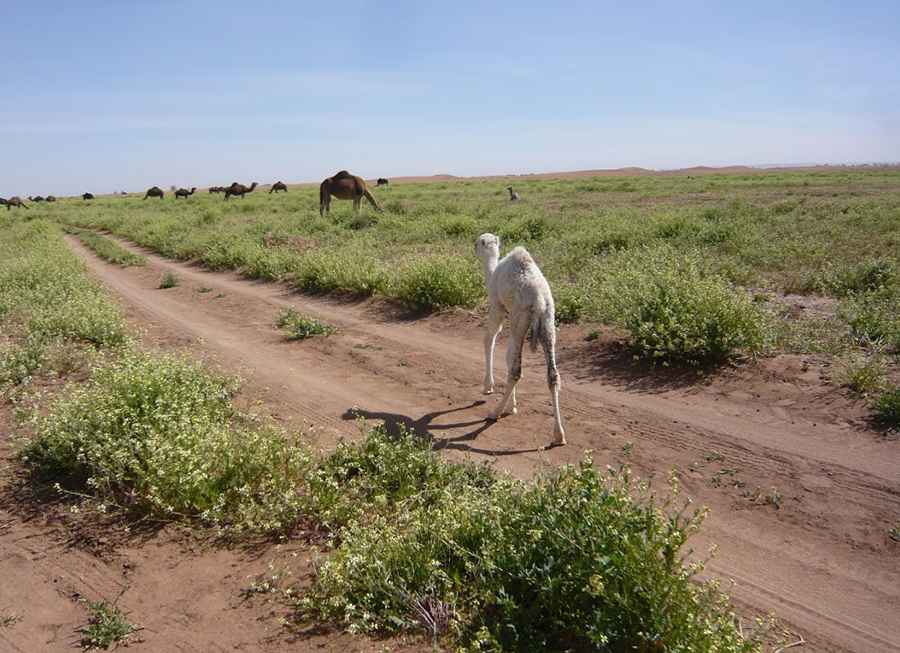
| Road facts: Erg Chigaga (from M'Hamid) | |
|---|---|
| Location | Zagora Province, Morocco |
| Length | 50 km (31 miles) off-road |
| Surface | Sand (Fech-fech), rocky Hamada, dry lakes |
| Vehicle Type | High-clearance 4x4 only |
How challenging is the 50km desert crossing to Erg Chigaga?
The journey from M'Hamid is a grueling test for any vehicle's cooling and transmission systems. The logistics of the drive involve three distinct terrains: the rocky hamada, where sharp stones can easily slice sidewalls; the chotts (dry lake beds), where high speeds are possible but deceptive mud pockets may exist; and finally, the deep sand of the dunes. At Chigaga, the "fech-fech" (fine flour-like sand) is a constant threat that can stall a vehicle instantly if momentum is lost. Maintaining a steady pace and knowing how to read the ripples in the sand is essential to avoid getting bogged down in areas where the ground has zero load-bearing capacity.
What are the main hazards on the route to the dunes?
The primary hazard is the total isolation and the volatile nature of the desert floor. There are no marked roads or safety barriers; the track is a shifting network of trails that can be erased by a single sandstorm. The heat is a physical factor that puts immense load on the radiator and oil temperature, especially when driving in low-range gears through the soft dunes. Visibility can drop to zero during a "sirocco" wind, making it impossible to distinguish between a flat lake bed and a dangerous drop. Furthermore, the proximity to the border and the absence of civilization mean that a mechanical failure, such as a snapped axle or a burnt clutch, becomes a high-isolation emergency.
Can you drive to Erg Chigaga without a guide?
Driving to Erg Chigaga without a knowledgeable local driver or professional desert navigation tools is a high-risk operation. The 50-kilometer transit takes at least 2 to 3 hours because of the technical nature of the ground. Navigating through the "labyrinth" of small dunes before reaching the main erg requires experience in choosing the right path to avoid soft pockets. Tire pressure management is the most critical logistical factor; you must drop pressures to increase the footprint on the sand and re-inflate them immediately once you hit the rocky hamada to prevent rim damage. Without these adjustments, a 4x4 will quickly overheat the transmission while struggling for grip.
What mechanical prep is needed for the M'Hamid desert track?
Before heading out from M'Hamid El Ghizlane, verify that your 4WD system, including low-range and diff-locks, is fully operational. Check your air filters; the fine Saharan dust will clog a standard filter in hours, so a snorkel or a pre-filter is highly recommended. Ensure your tires are All-Terrain or Mud-Terrain with reinforced sidewalls. Carry at least two full-sized spare tires, a high-lift jack, sand tracks (maxtrax), and a kinetic recovery rope. It is mandatory to carry at least 40 liters of extra fuel and 20 liters of water per person. In the Erg Chigaga, your vehicle's cooling efficiency and your recovery gear are the only safety nets between a successful crossing and being stranded in the heat.
Pic: Maxime Nicolazic