Driving the rugged Route de l'Assekrem in the Hoggar Mountains
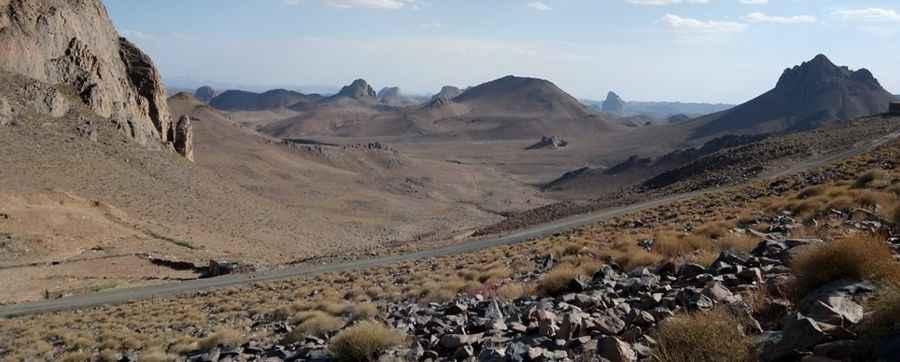
Assekrem is a high mountain plateau that reaches 2,708 meters in the Tamanrasset Province of southern Algeria. Located deep within the Hoggar Mountains (Ahaggar), the Route de l'Assekrem is one of the most legendary and punishing desert tracks in the Sahara. This is a world of twisted volcanic basalt and jagged peaks where the road is a constant battle against the "tôle ondulée" (corrugated road) and sharp rocks. Driving here means entering a silent, lunar landscape where the desert's heat and the mountain's altitude combine to push any 4x4 to its absolute limit.
| Road facts: Assekrem | |
|---|---|
| Location | Hoggar Mountains, Tamanrasset, Algeria |
| Elevation | 2,708m (8,884ft) |
| Distance | ~80 km from Tamanrasset |
| Duration | 3 to 4 hours (one way) |
How difficult is the drive to Assekrem from Tamanrasset?
The journey to the summit typically starts in Tamanrasset, and although the distance is only about 80 kilometers, the trip takes between 3 and 4 hours due to the brutal state of the track. The road is a mix of hard-packed dirt, loose volcanic gravel, and heavy corrugation that will rattle every bolt in your vehicle. A high-clearance 4x4 with reinforced suspension is mandatory. The track is steep and narrow in the final ascent toward the plateau, where sudden loose-gravel breaks can make the tires spin and lose traction. It is not just about the incline; it is about the constant vibration and the jagged stones that can slice through standard sidewalls in an instant.
What are the main hazards when driving the Route de l'Assekrem?
The primary hazard is the absolute isolation of the Hoggar. The desert can be deadly if you get lost or suffer a major mechanical failure, which is why taking a local guide is essential for both navigation and survival. Weather is another enemy: summers are scorching, while winter nights at 2,700 meters drop well below freezing. If it rains—even a light shower—the dust turns into a slick, soapy mud, and the "oueds" (dry riverbeds) can flash flood without warning, cutting off the track. Visibility can also be a problem during sandstorms, where the fine dust enceals the deep ruts and the sharp drops at the edge of the mountain path.
What mechanical prep is needed for the Assekrem summit?
Before leaving Tamanrasset, you must ensure your vehicle is in top mechanical shape. The dust of the Sahara is incredibly fine and will clog air filters quickly, so bring spares. Check your cooling system, as the engine will work hard on the steep climbs in low gears under the desert sun. At 2,708 meters, your engine will lose power, so you need the low-range gearbox to crawl over the rocky steps. Carry at least two full-sized spare tires, plenty of extra water (10 liters per person minimum), and enough fuel for a return trip plus a safety margin. On the descent, do not ride the brakes; the long, bumpy slopes will glaze your pads. Use engine braking in a low gear to keep the vehicle under control on the loose gravel.
What can you find at the top of Assekrem?
The summit is more than just a viewpoint; it hosts a communication tower, a global Atmosphere Watch station, and a mountain refuge for travelers. Most famously, it is home to the hermitage of Charles de Foucauld, built in 1910, which is still inhabited by a few monks. Reaching the top requires a good physical condition for the final hike from the parking area. The reward is what is often called the most beautiful sunset in the world, with the jagged volcanic "needles" of the Hoggar stretching to the horizon. October and November are the ideal months to visit, avoiding the extreme heat of the summer and the bone-chilling cold of the deep Saharan winter nights.
Pic: Khaled Ziani