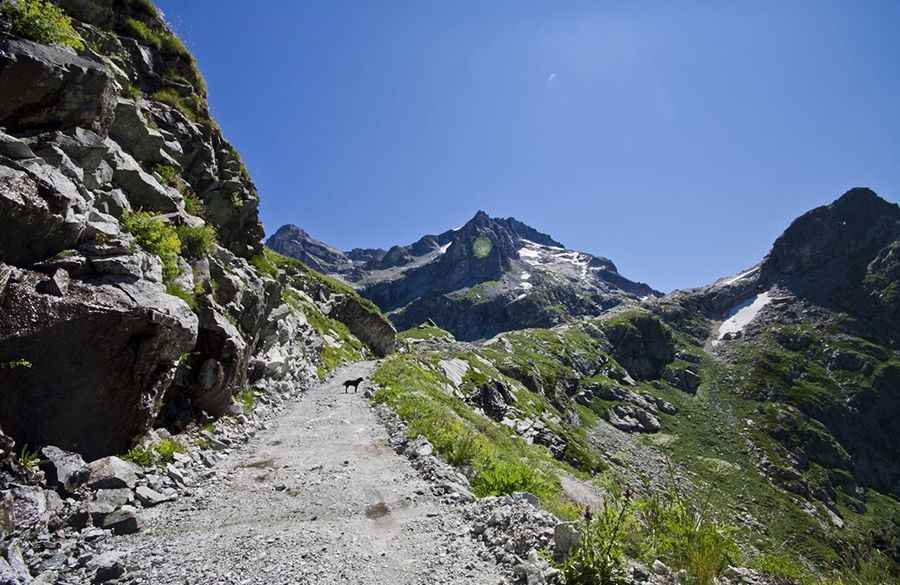
The Sukhumi Military Road is the historical name of the road through the Greater Caucasus (Klukhorskii Pass, 2,781 m), connecting the city of Cherkessk (Karachai-Cherkess Autonomous Oblast) with the city of Sukhumi (Abkhazian ASSR).
The Sukhumi Military Road is 337 km long. It passes through the mountain resort of Teberda and the Dombai fields, which are outstanding for their beauty. The road provides motor vehicle transportation (with a break between Teberda and Azhar). The Sukhumi Military Road is very picturesque, and tourism has developed along it.
The ancient trade route, which lay in the western part of the Greater Caucasus Range and crossed from north to south Caucasus, namely from Teberda Gorge to Georgia (Kodori or Dali gorge) was marked even on the ancient Venetian map that was drawn up by Francisco Pizzigani in the sixties of the XIV century. This road that was called "Turkish trail", passed through Klukhori pass (3292 meters above sea level), and connected North Caucasian mountaineers with the Georgians (Svans) and Abkhazians.
By the end of the Caucasian war a question of the expansion of the pedestrian road was put on the agenda in order to make movement of carts and carriages possible. Russian military body held a special interest in expansion of the road. And it is understandable as situation in the western Caucasus demanded constant change of deployment of troops. Accordingly, Russian military engineers created a project for the road construction by the end of the fifties of the XIX century.
Due to various political and economic reasons (Russian-Turkish war, financial problems) construction was delayed and intensive mountainous works only started in 1896. 337 km-long road started to function in 1903 and connected Stanitsa Batalpashinskaya (modern Cherkessk) of the North Caucasus with Sukhumi. And as it were mainly Russian militaries that built the road it was called Sukhumi Military Road.
Of course, it should not be understood as though the entire Sukhumi –Batalpashinskaya road transmitted the same volume of transport everywhere on its entire length and that it was passable both in summer and winter. Especially difficult part of it was a section from Lower Azhara to Teberda through Klukhori pass that was inaccessible from late autumn to spring.
In 1918 due to military and political situation in the North Caucasus Sukhumi Military Road was frequently used by Bolsheviks who were trying to cross over to Georgia and create chaos in Abkhazia. The government of the Georgian Democratic Republic securely closed Kodori (Dali) gorge and Soviet Russia did not threaten Georgia from this direction till 1921.
Soviet period: construction with "Stalinist enthusiasm"
After strengthening of the Soviet authority in the Caucasus in the beginning of the thirties when it was planned to build roads, together with expansion of the Zugdidi-Mestia highway a project of reconstruction of the Sukhumi Military Road was also drafted. But its realization from both sides (from Sukhumi and Mikoyan-Shakhar) was possible only up to outskirts of the Klukhori pass.
During the Second World War II Sukhumi Military Road acquired a very important role in the Germany-USSR North Caucasian military theatre. In summer of 1942 when the Nazis captured Teberda and Dombai and when they erected the German flag with swastika on the Mount Elbrus it can be safely said that fate of Georgia significantly depended on protection of the Klukhori pass.
According to the order of the Supreme Council of the Soviet Union of October 12th 1944 that became the beginning of the great repressions, Karachay Autonomous District was abolished and its southern part was incorporated into Georgia. According to the same order a new administrative unit - Klukhori district with its centre in the town of Klukhori (former Mikoyan-Shakhar) was created on the territory that was incorporated in Georgia.
Naturally, transport links of the new district of Georgia with its neighbouring district – Gulripsh and generally, with Tbilisi required strengthening and expansion. For this purpose there was a plan of another reconstruction of the Sukhumi Military Road. At that time the special attention was paid to building of the motorway immediately in the Klukhori pass. As Klukhori district newspaper Gantiadi stated construction started with "Stalinist enthusiasm", the road was partially asphalted and facilities protecting from Avalanches were built...
From 1946 most widespread transport of that time - a ton and a half weight lorries "GAZ" – freely moved across the Klukhori-Sukhumi highway (width of the road was 4 m). These lorries transported household goods and people as well. Number of tourist had also increased. Although, as in previous years, the main fault of the road was clearly-defined season nature of its transmittance - even "Stalinist enthusiasm" was not enough for snowy Klukhori pass.
We should hereby mention that in the second half of the forties the Klukhori airport was also built and flights of Klukhori-Sukhumi and Klukhori-Tbilisi were established. But difficult landscape of the mountainous Caucasus and climate conditions have interfered again. Conduction of flights was often impossible due to them.
Abandoned road and gorge
In 1955 after the Klukhori district was transferred to Russia the Klukhori gorge section of the Sukhumi Military Road has lost its communicative importance. Due to inappropriate lack of maintenance the road became destroyed and inaccessible for automobiles with the time. From the sixties of the previous century only parts of the Sukhumi Military Road that functioned were in the southern part - section till a tourist camp –Yuzhny Pryut situated near the village of Omarishara and in the north a section till Severny Pryut. Of course, from time to time these sections of the road and its infrastructure were restored. As to the Klukhori pass (approximately 15-20km) nature reasserted its power here. The road became accessible only for pedestrians and horses as it was before. Only some remains of the past glory were left there – road posts, asphalt... But this, at the first glance, negative event had its bright side as well. Ecological situation improved, more tourists were coming to this area... Just some 20-25 years ago a tourist trail of national importance passed here that was very popular.
In 1992-1993, during the Georgian-Abkhazian conflict, the Kodori (Dali) gorge was securely protected from anti-Georgian actions of North Caucasian volunteers as it was in 1918-1921. Georgians that lived there at the expense of their lives heroically defended their gorge. Therefore Abkhazians could not manage to capture the gorge. Due to the state of war the road did not function.
The road was remembered in the North Caucasus twelve years ago - in 1998. Project of reconstruction and expansion of the road was part of the election campaign of the presidential candidate for Karachay-Cherkessia Stanislav Derev. Preliminary tests were done at that time but, as it always happens, pre-election promise was just a promise.
Unfortunately, after the war in August 2008, this entire territory appeared in the hands of the authorities of breakaway Abkhazia and accordingly they completely control the southern part of the Sukhumi military road.
From that moment Abkhazians have been thinking about the construction of the road.
Statements became especially frequent from 2009 both from Abkhazia and Karachay-Cherkessia. Sergei Bagapsh and Boris Ebzeev almost simultaneously began talking about necessity of restoration of this road. It is interesting that this project has both many supporters and opponents.
Arguments: "pros" and "cons"
Pros: Those who are for restoration of the road maintain that this is ethno-political and economic project that will promote North Caucasian and Abkhazians becoming even closer. The distance is significantly decreased. For example, it will be possible to go from Nalchik to Sukhumi in one day. Level of economic and trade cooperation will increase, tourist number will grow and western Caucasus will become "major ski and sea resort". For Russia the Sukhumi Military Road will be a reserve route from Russia to Abkhazia. As of today there is just one single land route into Abkhazia (from Sochi) while for Karachay-Cherkessia which is a kind of transport dead-lock today, this road will be a "window" to the Black Sea. Besides, as supporters maintain, restoration of the road will positively affect security of the Sochi Olympics, unemployment will be reduced, and provision of the Russian troops deployed in Abkhazia will become more stable. If this road is given an inter-state status it will increase level of protection of the Kodori gorge and so on.
Cons: According to opponents restoration of this road is too early for Abkhazia. "Abkhazia is a weak state and it will not be able to operate and maintain the road. Besides it will be economically unprofitable. In short, it is not worth putting money in it". By the way this position was shared by Abkhazian businessman and politician Beslan Butba in 2009. The opponents say that the project will be very expensive. it will cost Karachay-Cherkessia 10 billions and Abkhazian side - 22-23 billion rubles. But as deputy head of the federal road department Anatoly Ozov said neither of them have money and a political decision of the Russian leadership was needed. It is interesting that in Ozov's opinion it was better to build Cherkessk-Adler road that would pass on Krasnaya Polyana and would be used for the entire year as opposed to the Cherkessk-Sukhumi road.
Opponents have another argument. Introduction of large number of modern construction equipment and their usage in the Klukhori gorge as well as explosions of mountain rocks will put the region under threat of environmental catastrophe. And if the road is built still and there is intense movement on it then one should say farewell to wonders of the Caucasus - recreational zones and natural reserves of the Teberda and Dali gorges.
By the way last month there was a small scandal with connection to the idea of construction of the Sukhumi Military Road. Former fighters of the now-abolished mountain rifle regiment of the Abkhazian defence ministry who before August 2008 were deployed in the Kodori gorge at the line of confrontation , became desirous of starting business and asked the government to allot them lands in Kodori gorge (to build patskhas (cabins). They hoped that as they had fought and defended this territory from Georgians they deserved to be given lands. Requests of the former fighters were not satisfied. More, force was used against them. They organized a protest rally because of such treatment of them. As Abkhazian Prime Minister Sergei Shamba said a national park should be established in the gorge and therefore transfer of lands is limited. In addition, according to him due to construction of the "geo-strategically" important road of the Kodori gorge, chaotic appropriation of lands there is unacceptable.
Of course, taking care of environment of the gorge is laudable but there is contradiction in the words of Shamba. If it is intended to create a national park in the Kodori gorge would not construction of the "geo-strategically" important road with its modern infrastructure damage the national park?
One wants to believe but it is very difficult. Let's return to the plan voiced by Putin about the restoration of the Sukhumi Military Road.
Construction with "Putin enthusiasm"?!
Generally, it is known that Russian Prime Minister is mainly characterised by Soviet methods of leadership amd management. He likes very much the Black Sea coastline of Georgia – Abkhazia as well as Sochi-Taupse strip. We should remember that just some 90 years ago the latter was also a part of Georgia. Holiday homes and residences of Russian leaders are situated on this territory... It is also known that it was personal decision of Vladimir Putin to choose Sochi and Krasnaya Polyana as Olympic venues in 2014. It is notable that he personally controlled construction of the Sochi-Krasnaya Polyana road in 2005.
As we can see the former "KGB" officer has some experience in this matter as well. And it is not surprising that the Russian Prime Minster supported the construction of this road at the Edynaya Rossia party conference. So we should suppose that political decision has already been made. Probably, construction will first start in Karachay-Cherkessia and later, with the financial and material help of Russia, in Abkhazia as well.
Position of Georgia
In general, any social-economic project that serves integration of Abkhazia with Russia is politically unprofitable for Georgia. First of all, commencement of Transcaucasian construction of regional importance on the occupied territory is, to say mildly, against international norms. And secondly, projects of economic development of Abkhazia are better to be prepared with participation of relevant Georgian government bodies. And if any of the projects, as an exception, is prepared without Tbilisi it should be examined in the Georgian government.
But we should suppose that Sukhumi and Moscow will not probably pay any attention to Tbilisi position. Such attitude should be understandable for us as, opposed to previous years, now Georgian government does not control the Kodori (Dali) gorge. This once again confirms that the war with Russia in August 2008 had disastrous results for Georgia.
Now we should direct our efforts towards preventing the construction of the road. For this purpose we should use norms of international law, involve regional environmental NGOs and so on. Anti-Georgian plans of Bagapsh, Ebzeev and Putin should not be fulfilled.