Dangerous Roads

  • Increase font size
  • Default font size
  • Decrease font size

Adriatic Highway (Croatia)

E-mail Print PDF
User Rating: / 0
EasyScary 


The Adriatic Highway is a road that stretches along the eastern coast of the Adriatic Sea and is part of the European route E65. The road passes principally through Croatia, with smaller stretches through Bosnia and Herzegovina and Montenegro.  


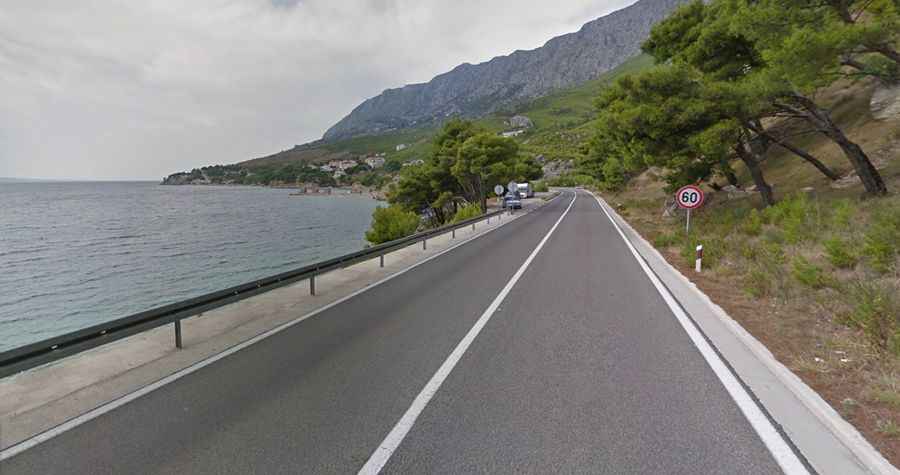
Is a marvellous road to drive or bike, though risky - its serpentine twists and turns sometimes ornamented by skidmarks leading to a hole in the crash barrier, the sea hundreds of feet below. It’s a route of dramatic karst scenery, with clear blue water to one side, and the view of islands in the distance. It is still a two-lane road for almost its entire length, with the exception of a short dual-carriageway expressway between Sveti Juraj near Kaštela and Split. That expressway section is planned to be expanded to span Trogir and Omiš.


Croatian section of the highway is officially named D8 state road (Croatian: Državna cesta D8), and it runs from Slovenian border crossing via Rijeka via Senj, Zadar, Šibenik, Split, Opuzen and Dubrovnik to the border with Montenegro at Karasovići. Most of the D8 is still a two-lane road, excepting rare four-lane stretches. Total length of the road through Croatia is 643.1 kilometres (399.6 mi).

Until recent times the road has been the primary route connecting Adriatic coastal parts of Croatia. Since the 2000s multilane motorways have taken over most of its traffic, and yet more motorways are still being built along the coast. The motorways parallel to the road are A7 (Rupa broder crossing - Rijeka - Sveti Kuzam), A6 (Rijeka - Bosiljevo) and A1 (Zagreb - Bosiljevo - Zadar - Split - Ravča). Since D8 state road closely follows the well-indented Croatian coastline, travel is considerably longer and less safe compared to the motorways because of numerous blind curves and at-grade intersections. D8 state road is still popular as an alternative to the tolled motorways, so the road carries fairly constant traffic during most of the year. The traffic intensifies in the summer, because of substantial traffic to touristic destinations.

The section from Rijeka to Senj experiences heavy traffic in particular because many motorists are unwilling to take the longer route along A6 and A1. This problem used to be further exacerbaced before 2009 when A6 still had slow semi-highway parts on the Rijeka-Bosiljevo route. This section shall remain congested at peak intervals until eventual completion of A7 motorway between Rupa and Žuta Lokva.

Since parallel A1 motorway ends at Ravča, approximately 30 km (20 mi) northwest of Ploče, southbound A1 traffic generally switches to D8 state road. Further 30 km (20 mi) after Ploče D8 road terminates at Klek border crossing to Bosnia and Herzegovina, as Adriatic Highway route runs across a tiny strip of Bosnia and Herzegovina territory around town of Neum. As the route reenters Croatia at Zaton Doli border crossing D8 state road resumes, running to Dubrovnik along the coastline. East of Dubrovnik the road passes by Dubrovnik Airport and reaches the border with Montenegro at Karasovići border crossing to Montenegro.


There are official plans to build an expressway bypassing Neum in Bosnia and Herzegovina entirely via a series of tunnels and bridges, Pelješac Bridge being the most notable among them. The route would diverge from current D8 route south of Ploče, cross the bridge to Pelješac peninsula, form a junction to D414 state road and rejoin present D8 route near Doli. The expressway is to be tolled. So far no official road number has been assigned to the planned route, even though Pelješac Bridge construction was started. It is also possible that D8 designation shall be transferred from the bypassed D8 section to the expressway. D8 is the longest state road in Croatia at 643.1 km (399.6 mi).

The road, as well as all other state roads in Croatia, is managed and maintained by Hrvatske ceste, a state-owned company

Traffic is regularly counted and reported by Hrvatske ceste, operator of the road. Substantial variations between annual (AADT) and summer (ASDT) traffic volumes are attributed to the fact that the road carries substantial tourist traffic.

Traffic volume on the D8 state road varies greatly, as the road runs through areas of more or less developed tourist industry. Furthermore the road runs through or near a number of major Croatian cities, such as Rijeka, Zadar and Split which add to the traffic volume significantly. Thus the most congested section of the D8 state road is found in the city of Split, between Solin and Stobreč, where the greatest AADT figures are regularly recorded, far exceeding comparable figures of the busiest motorway sections in Croatia. Conversely, the lowest traffic volume on the D8 road is observed near Karlobag due to comparatively less developed tourism and absence of major cities in the area. The AADT recorded on the D8 road observed in Split (Solin and Stobreč) is nearly 50 times greater than in Karlobag.


The highway passes through a small strip of Bosnia and Herzegovina territory at Neum. The border crossings are at Neum 1 (with Klek on the Croatian side) to the west of Neum, and Neum 2 (with Zaton Doli on the Croatian side) to the east. Travellers not going to Bosnia and Herzegovina usually aren't inspected by customs officers. A passport must be shown, but is often not checked. The road from Neum to the rest of Herzegovina is in a bad shape.

An alignment entirely through Croatia is currently in the early stages of construction, hopefully eliminating the need for crossing the two borders via proposed Pelješac Bridge.

Within Montenegro, the two-lane road runs from Herceg Novi through Tivat, Budva, Petrovac, Sutomore, and Bar to Ulcinj. The traditional highway runs around the Kotor Bay through Kotor, but through traffic uses the ferry connection across the Verige Strait between Herceg Novi and Tivat.


The Montenegrin section, albeit as narrow as Croatian, still remains the only feasible route along the Adriatic coast. No litoral motorways are planned in Montenegro yet.

There are two major roads from the Adriatic Highway to inland Montenegro – at Budva, via Cetinje, and at Sutomore, via Sozina tunnel. It merges with Croatian road network at the Debeli Brijeg border crossing near Herceg Novi, and ends east of Ulcinj. From Herceg Novi to Haj Nehaj, near Sutomore, it is the part of European routes E65/E80, which then transforms into European route E851.

Verige bridge spanning the Bay of Kotor and part of the Adriatic Highway is planned to be built in the future.


Compared to the other roads, the coastal roads of Croatia may look childish, but that’s not the case. The coastal roads and the fast-driving Croats that crowd them probably account for more deaths and injuries than accidents associated with unexploded ordinance ever do. You have rocks on one side, sea on the other; add in some eastern European driving standards - some of the worst in Europe according to the stats.


Add comment


Security code
Refresh

Search

Bealach3.jpg

Haunted roads

Tuen Mun Road (China)


Legends of this road being haunted go back hundreds of years. The Tuen Mun Road, in Hong Kong, has seen more of its fair share of tragic, fatal car accidents.

Read more...

Who's online

We have 31 guests online

News

Red Bull Terramar: engines roar again in Spain the first circuit

Earthsea (Sitges), was next to Brooklands, concerning motor racing in Europe in the 20's and marked the start of racing in Spain. The drivers Carlos Sainz and Miguel Molina have had the privilege of shooting one of the most demanding ovals in the world (with a banking of 90 degrees), abandoned for years.

Read more...
 
2012 Giro d’Italia

The 2012 Giro d'Italia is the 95th edition of Giro d'Italia. It started in the Danish city of Herning, and will end in Milan. The complete route of the 2012 Giro d'Italia was announced in mid October. For the first time since the 2007 edition no climbing time trial is included in the route.

Read more...
 
How to drive in the mountains of Colorado

The leaves are turning, snow season is on the horizon and more people are heading into the mountains for weekend trips. But before you travel Colorado mountain roads, there are a few things you should know.

Read more...
 
Sébastien Ogier and Carlos Sainz test Polo R WRC in Spain

Acid test for the new Polo R WRC: Volkswagen factory driver Sébastien Ogier and the former World Rally Champion Carlos Sainz put the Polo for the WRC to a tough test in Spain.

Read more...